
- Last Updated: 13 May 2026
Supply Chain Finance in Australia
Improve cash flow across your supply chain. Supply chain financing gives suppliers faster payments and buyers more time to pay.
- Suppliers get 100% of the invoice value within hours*
- Buyers can defer payments
- The whole process can be done electronically
How to Apply for Supply Chain Finance with Dark Horse Financial
1
Contact Our Team
Fill out our online form to apply for supply chain finance. One of our specialists will get in touch with you fast to understand your situation and make a recommendation.
2
Submit Application
We’ll expertly handle your application from start to finish. Some SCF lenders can approve applications within the same day.
3
Get Funded
Once the lender approves your application, you can now gain access to their digital platform, which can help you facilitate SCF and receive the funding you need.
Rated by Our Clients on Google
EXCELLENT Based on 24 reviews
 Posted on Google
 Jordan Bella
Trustindex verifies that the original source of the review is Google.
Jeff worked tirelessly to get an equipment finance and overdraft facility in place for our growing business under some very unique & challenging circumstances after we'd previously been pushed away by our banking partner. Working with the DHF team was seamless!Posted on Google Finnen ElectricalThe team at Dark Horse Financial were fantastic to deal with when helping me organise finance for my business. Jeff was an absolute dream to work with, no problem or issue was ever too big, and he made everything happen quickly and smoothly. What I thought might take weeks was sorted in a matter of days, and the finance itself was approved within a day. I’ve used plenty of finance companies and lenders before over the years, but the service from Dark Horse Financial is second to none. I’ll definitely be sticking with them from now on. Highly recommend Jeff and the team.Posted on Google
 Ainsley BennettJeff and his team have been a fantastic help to us. His prompt service and wide array of knowledge in the financial sector has made our dealings very easy. Thanks Jeff!Posted on Google
 Rhys GormanHighly recommend working with Jeff for any financial needs for your business - I wish I had have engaged him years ago. He takes a huge amount of the stress away from dealing with banks and lenders and simplifies what can be a very convoluted process. His proactive, professional, and caring approach has served me and my business extremely well and there is no one else I would turn to for our lending needs in the future other than Jeff.Posted on Google
 Michael StarkeJeff was exceptional in his communication and guidance throughout the entire process. He secured a credit facility for our startup when others couldn’t, demonstrating his expertise and dedication. We’re excited to continue working with Jeff as our business grows and our needs evolve.Posted on Google
 Michelle ReevesJeff made the impossible possible! Highly recommend Darkhorse for your finance needs. Wonderful service.Posted on Google
 Scott DoranI had the pleasure of working with Jeff, and I couldn't be more impressed. As a finance broker, he was extremely helpful throughout the entire process. His communication was clear, timely, and thorough, making everything so much easier to understand. He took the time to explain all my options, ensuring I was well-informed every step of the way. I felt confident and supported in his hands. I will definitely be using Jeff again in the future and highly recommend his services to anyone looking for expert financial advice!Posted on Google
 Henry FriendJeff is our one stop shop for all lending/debt services. I would highly recommend Dark Horse!Posted on Google
 Roger MuliainaVery happy with the result achieved. Jeff was supportive optimistic and very clear on the approach which I appreciated. True processional, punctual in his correspondence and genuinely cared about our situation. Cannot recommend him enough.Posted on Google
 Gareth TurnerJeff was professional helpful and efficient. I called him and had an overdraft facility sorted within 24 hours.
What is Supply Chain Finance?
Supply chain finance (SCF), also known as reverse factoring, is a financing arrangement that benefits both buyers and suppliers. It lets suppliers choose to get paid sooner and gives buyers the option to extend their payment timelines. This balance helps improve cash flow across the supply chain and makes things easier on both sides financially.
In practice, SCF is often set up with the help of banks or non bank finance providers, using digital platforms that streamline invoice approval, payment, and funding.
SCF is not a traditional loan. It helps businesses free up cash that is tied up in invoices and keep the cash flow in the supply chain healthy.
How Supply Chain Finance Works
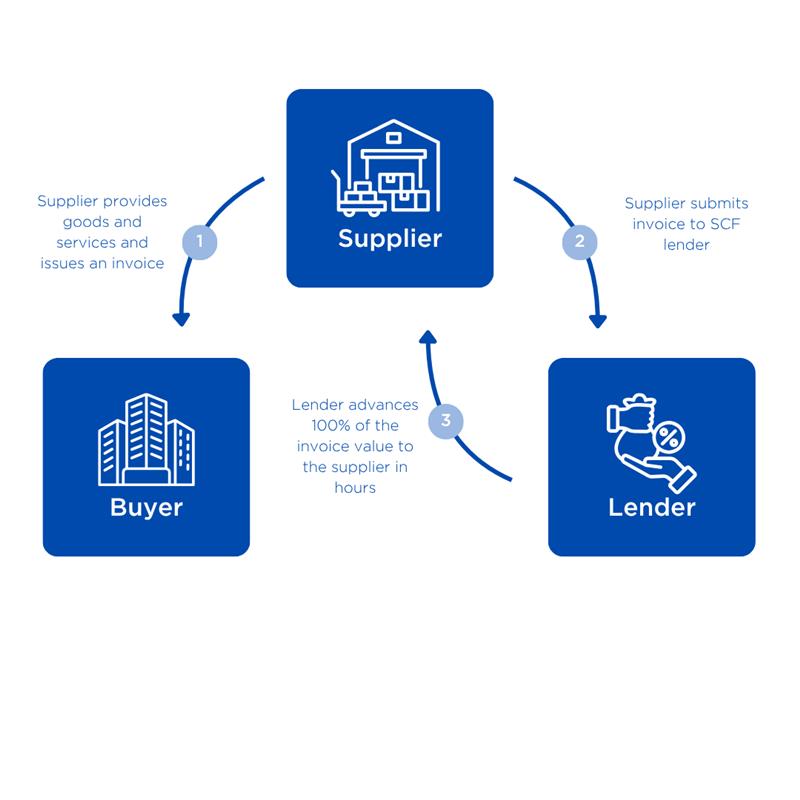
Most supply chain finance platforms in Australia operate online, which means invoices can be uploaded, approved, and funded quickly. This digital approach makes the process efficient and reduces administrative workload. Here’s how the process works in practice:

Step 1: Supplier Issues an Invoice
The supplier delivers goods or services as agreed and issues an invoice to the buyer.

Step 2: Finance Provider Pays Supplier
The supplier gives the invoice(s) to a finance provider and receives 100% of the invoice(s) amount within hours.

Step 3: Buyer Defers Payment
The buyer (client) does not need to pay immediately. Typically, there is no payment required until the end of the first month, giving the business extra breathing room.

Step 4: Buyer Repays in Instalments
Over the following months, the buyer repays the finance provider in instalments plus fees.
Who Can Use Supply Chain Finance in Australia?
Both large corporations and small to medium sized businesses can easily access supply chain finance. Since extended payment terms can strain a small business’s cash flow, small businesses especially benefit. Both suppliers and buyers can maintain operations and improve their financial management with SCF. Businesses in industries with long payment terms, such as manufacturing, wholesale distribution, retail, and construction, are common users.
Benefits of Supply Chain Finance

Benefits for Buyers
- Extended Payment Terms: Buyers can extend payment terms without straining supplier relationships.
- Improved Working Capital: Freeing up cash flow allows buyers to reinvest in growth or operations.
- Strengthened Supply Chain: By supporting suppliers, buyers reduce risks of supply chain disruptions.

Benefits for Suppliers
- Faster Access to Cash: Suppliers can access early payment, often at lower financing costs compared to traditional loans.
- Improved Liquidity: Better cash flow helps suppliers manage daily operations and invest in growth.
- Stronger Partnerships: Being part of an SCF program enhances long term business relationships with buyers.

Benefit for Both
Digital Efficiency: Many SCF platforms use technology that simplifies invoice and payment management.
The Role of Technology in Supply Chain Finance
Modern SCF platforms rely heavily on digital solutions. In Australia, SCF is mostly done online from start to finish, making the process easier for all parties involved.
This process can reduce manual errors, improve transparency, and allow businesses to track cash flow in real time. This is very convenient, especially for businesses operating across multiple suppliers and markets.
Supply Chain Finance vs Factoring
Factoring and supply chain finance are similar, but they have key differences. This is how they are distinct from each other:
- Invoice Factoring is when a supplier sells their invoices (receivables) to a finance company, usually at a lower price, so they can get cash right away.
- Supply chain finance allows suppliers to access 100% of an invoice’s value, but the buyer also benefits by giving them a longer time to repay.
Is Supply Chain Finance Right for Your Business?
Deciding whether SCF is the right solution depends on your role in the supply chain and your financial goals.
- If you are a buyer, SCF can help strengthen supplier relationships while giving you greater control over working capital.
- If you are a supplier, SCF offers quicker access to cash without the burden of traditional debt.
Assessing your supply chain needs, industry norms, and cash flow requirements will help determine if SCF is right for you.
Frequently Asked Questions
Reverse factoring is another name for supply chain finance. In this arrangement, suppliers can receive 100% of their invoice(s) value within hours, while clients have several months to pay in instalments plus fees.
Buyers can extend payment terms without harming supplier relationships, preserve more working capital available, and build a more reliable supply chain. With SCF, buyers don’t have to pay until the end of the first month, and they have months to pay the lender in 4 instalments.
Yes. Supply chain finance can benefit businesses of all sizes. SCF can benefit small and medium sized businesses by smoothing out cash flow gaps and making them more competitive with larger players.
Banks, non bank lenders, and specialised finance companies in Australia all offer supply chain finance services. We can help you find a provider that can meet your needs and get you funded when you need it.
No, SCF is not a loan in the traditional sense. Supply chain finance is usually off balance sheet for suppliers and doesn’t add debt in the way a business loan does. Instead, it’s a cash flow tool that speeds up payments.
At most lenders, supply chain finance extends to domestic suppliers only but there are trade and import finance lines of credit and other facilities that can be used to pay international suppliers while preserving your cash flow.
In many cases, suppliers can access funds within a few hours of invoice approval, depending on the provider and the agreement.