


An ANZ LMI waiver lets eligible professionals such as accountants, lawyers, doctors and dentists borrow above the usual 80% loan-to-value ratio without paying lenders mortgage insurance, as long as they meet ANZ’s current profession, ownership and residency criteria. ANZ is far from the only bank doing this though. NAB, Westpac and a handful of other lenders have their own versions, and a broker can put them side by side for you.
Introduction
Ask anyone who has bought a home lately what the hardest part was and most will say the deposit, and the sting in the tail of a small deposit is lenders mortgage insurance. Buy an $800,000 place with a 10% deposit and the LMI premium can land somewhere north of $20,000 depending on the insurer and the size of the loan, and here is the part that annoys people, that money protects the bank, not you. It comes on top of stamp duty, legal fees, removalists, the lot.
Professional LMI waivers exist to take that cost off the table for certain occupations. ANZ publishes its own waiver policy, NAB and Westpac and a few non-bank lenders publish theirs, and the upshot for an eligible accountant, lawyer or doctor is that you can buy sooner with less deposit and skip the premium entirely. We should be upfront about something before going further: Dark Horse Financial is a finance broker with a large panel of lenders, and ANZ happens to be one of them. We are not ANZ, we have no exclusive partnership with ANZ, and our job is to weigh ANZ’s policy against the alternatives so you can look at your low deposit home loan options with clear eyes.
Key Takeaways
- LMI on an $800,000 purchase with a 10% deposit can cost $20,000 or more, and it protects the lender, not you.
- ANZ publishes LMI waiver fact sheets that set out eligible professions and LVR limits: up to 90% LVR for accounting and legal professionals and up to 95% LVR for medical and dental practitioners and specialists.
- NAB, Westpac and several non-bank lenders publish comparable no-LMI professional policies, so ANZ is one option among many.
- "LMI waiver" recorded around 720 searches a month in Australia against roughly 20 for the ANZ-specific term (Semrush, August 2026), which tells you most borrowers are shopping across lenders rather than searching for one bank.
- Dark Horse Financial is Credit Representative No. 465325 of Buyers Choice Licencing Pty Ltd (Australian Credit Licence 509484), with a large lender panel and no exclusive ANZ arrangement.
- Eligibility varies by lender and changes periodically, so every figure in this article should be confirmed against the lender's current policy before you rely on it.

What Is Lenders Mortgage Insurance (LMI) and When Do You Need It?
LMI is a one-off premium the lender charges when your deposit is under 20% of the property value, or put another way, when the loan-to-value ratio (LVR) creeps above 80%. If you default and the bank sells the place and still comes up short, the insurance covers the bank’s loss. You pay for it. You are not the one it protects, which is a point worth sitting with for a moment.
How much depends on the loan amount and the LVR, and both of those push the number up together, a bigger loan at a thinner deposit being the worst combination. ANZ’s own guide calls it a very rough figure of more than $10,000 on a $500,000 loan where the buyer has $50,000 saved. Stretch that out to an $800,000 property with an $80,000 deposit and a $720,000 loan at 90% LVR and you are looking at $20,000 or more, though the exact number sits with whichever insurer’s rate card the lender is using that month.
Most lenders will let you add the premium to the loan instead of paying it at settlement, which helps the cash position but means you pay interest on it for 25 or 30 years. Either way it is money that never touches the property. We have written more about how it works in our guide to understanding LMI.
How to Avoid or Reduce LMI in Australia
There are really only four ways around LMI, and which one fits depends on how much you have saved, whether family can help, and what you do for a living.
- Save a full 20% deposit, which removes LMI entirely at any lender.
- Use a family guarantor loan, where a parent or close relative offers equity in their own property as additional security.
- Access a government scheme, such as the Australian Government 5% Deposit Scheme (formerly the Home Guarantee Scheme), which lets eligible first home buyers purchase with a 5% deposit and no LMI, with the government guaranteeing the shortfall.
- Qualify for a professional LMI waiver at ANZ or another lender, which lets eligible professionals borrow above 80% LVR with the premium waived.
Save a 20% Deposit or Use a Guarantor Loan
Lenders settle on 80% LVR as the point where they are comfortable without insurance, and on an $800,000 property that is a $160,000 deposit before you have paid a cent of stamp duty, which for a lot of buyers means years more saving while prices keep drifting away from them. A guarantor loan is the usual workaround. A family member puts up part of the equity in their own home as extra security, the combined position drops to 80% or under, and the LMI disappears. The catch is that the guarantor is genuinely on the hook, because if the borrower defaults the lender can come after the guarantor’s property for the guaranteed slice, so both sides should get independent legal advice before anyone signs.
Access a Professional LMI Waiver
A professional waiver drops the LMI premium for borrowers in occupations the lender regards as lower risk, and in practice that means accounting, legal, medical and allied health. At ANZ the tiers are 90% LVR for accounting and legal professionals and 95% LVR for medical and dental practitioners and specialists, provided registration is current and the other conditions we cover below are met. Bear in mind the waiver removes the premium and nothing else. Income, living expenses, other debts, credit history, the valuation, all of it gets assessed exactly the same way as any other home loan.
What Is an LMI Waiver and Which Lenders Offer One?
An LMI waiver is simply a lender choosing to lend above 80% LVR without charging the insurance premium it would normally insist on. There is no government body behind it. Each bank writes its own list of eligible occupations, sets its own LVR ceiling, attaches its own conditions, and can rewrite any of it whenever it likes, which is why no two policies line up neatly.
Depending on the lender and the profession, an LMI waiver might get you to 90% LVR, and in some cases 95%, with no premium. ANZ sets its policy out in a series of LMI waiver fact sheets covering accounting, legal and medical professionals. NAB has an LMI waiver page covering medical, financial and legal professionals, and Westpac runs a healthcare LMI waiver that takes medical practitioners to 95% LVR and a longer list of health professions to 90%.
A few non-bank and specialist lenders have their own professional no-LMI policies as well, and the 2026 comparison coverage from Canstar, Finder and Eden Emerald Mortgages treats this as a multi-lender market, not an ANZ one. An ANZ LMI waiver is one road to a no LMI home loan. It is not the only road.
ANZ's LMI Waiver Policy Explained
ANZ’s waiver sits inside its ordinary home loan range rather than being a product on its own. To say it again, because it matters, Dark Horse Financial is a broker with access to this policy alongside those of a large number of other lenders, we are not ANZ, and we have no exclusive arrangement with the bank. Everything below comes from ANZ’s published LMI waiver fact sheets, which at the time of writing carry an August 2024 issue date, so please treat each figure as something to reconfirm against the live sheet rather than gospel.
The policy works in tiers. Accounting and legal professionals can go to 90% LVR without LMI, so a 10% deposit plus stamp duty and costs, while medical practitioners, dental practitioners and specialists registered with AHPRA can go to 95% LVR on a 5% deposit plus costs. A second group of health professions, at the moment physiotherapists, chiropractors, optometrists and vets, sits in the 90% tier. ANZ also states there is no minimum income requirement attached to the waiver itself, although the normal serviceability assessment still applies in full and decides what you can actually borrow.
Eligible Professions and LVR Limits
This is what ANZ’s fact sheets currently list. Membership or registration has to be current, and ANZ’s own list is the one that counts if anything here is out of date.
- Up to 90% LVR, no LMI: accountants holding current membership of an eligible institute (ANZ lists CA ANZ, CPA Australia, the CFA Institute and Fellowship of the Institute of Actuaries of Australia among others), lawyers, solicitors, barristers, judges and magistrates holding a current practising certificate, and physiotherapists, chiropractors, optometrists and veterinarians.
- Up to 95% LVR, no LMI: medical practitioners, dental practitioners and medical specialists holding current general or specialist AHPRA registration.
ANZ’s fact sheet goes out of its way to name nurses, pharmacists and psychologists as examples of occupations that do not qualify, and that matters because some of those same professions do qualify at other lenders, which we come back to further down.
Property Value Caps and Other Eligibility Requirements
There are dollar caps on top of the profession test. Houses and townhouses need to be valued at $5 million or less and units at $4 million or less, with higher thresholds in certain postcodes, total ANZ home loan exposure cannot go past $8 million, and the most you can borrow against a single security is $4.5 million for accounting and legal applicants or $4.75 million for medical and dental applicants.
Then there are three conditions that apply whichever tier you fall into. Where there is more than one borrower, the eligible professional has to hold at least an equal or majority share of the property. Registration or membership has to be current, not provisional and not non-practising, with some leeway for temporary absences like parental leave. And on residency, ANZ’s criteria go wider than citizens and permanent residents, noting that holders of some temporary or provisional visas currently on the Medium and Long Term Strategic Skills List (MLTSSL) may also be accepted.
Which Professions Typically Qualify for LMI Waivers
Look across every lender that publishes a professional waiver and the same groups turn up again and again: accounting and finance, legal, medical and dental, and allied health. The logic is the same everywhere. These are regulated professions with stable and usually rising incomes and very low default rates, so the bank is happy to carry a higher LVR without insuring it.
One thing that trips people up is that eligibility is assessed per applicant rather than per household. If one of you is in an eligible profession and the other is not, what happens next depends on the lender’s ownership rules, and a couple where the eligible partner would end up with a minority share of the property should check the policy before assuming the waiver will apply.
Accounting, Legal and Allied Professionals
Accountants generally need current membership of a recognised professional body, and the accepted lists differ a little from bank to bank. ANZ takes CA ANZ, CPA Australia and a range of overseas bodies within the Global Accounting Alliance, plus CFA charterholders and actuaries, and NAB’s list runs along similar lines. Lawyers need a current practising certificate from their state or territory regulator, and ANZ will accept a certificate that carries supervised practice conditions, which is handy if you are only a year or two out of law school. Allied health professions such as physiotherapy, chiropractic, optometry and veterinary practice usually land in the 90% LVR tier, and at some lenders that tier comes with a minimum income condition that the medical tier does not have.
Medical and Health Practitioners
Doctors, dentists and specialists get the most generous terms at nearly every lender, commonly 95% LVR without LMI. The common thread is current AHPRA registration in a general or specialist category, and lenders tend to knock out provisional, limited and non-practising registration. Some lenders take hospital-employed doctors from intern level up, which means this tier opens earlier in a medical career than most people assume.
Where it gets interesting is the professions that sit just outside the top tier, because the lenders disagree. ANZ leaves nurses, pharmacists and psychologists out altogether, whereas Westpac will give registered nurses, midwives, pharmacists, psychologists and a long list of other health roles a waiver to 90% LVR provided they earn at least $90,000 a year. A nurse who gets a no from one bank can quite easily get a yes from the next.
Comparing LMI Waiver Policies Across Lenders
The table below puts the published professional LMI waiver policies of ANZ, NAB and Westpac next to each other as at the last reviewed date, and every row is taken from that lender’s own published material, which you will find listed under Sources. Dark Horse Financial accesses ANZ’s publicly available policy as one option among a large lender panel, with no exclusive ANZ arrangement.
| Lender | Eligible professions | Max LVR without LMI | Property value cap | Notes and source |
|---|---|---|---|---|
| ANZ | Accountants (eligible institutes), lawyers, solicitors, barristers, judges, magistrates, physiotherapists, chiropractors, optometrists, vets; medical practitioners, dental practitioners, specialists (AHPRA) | 90% for accounting, legal and listed allied health; 95% for medical, dental and specialists | Houses and townhouses up to $5M, units up to $4M (higher in some postcodes); $8M total ANZ exposure; $4.5M or $4.75M per security | No minimum income specific to the waiver; equal or majority ownership required; some MLTSSL visa holders may qualify. Source: ANZ LMI waiver fact sheets (08.2024) |
| NAB | Medical professionals (AHPRA registered, 18 listed roles including doctors, dentists, pharmacists, physiotherapists, vets), financial professionals (CAs, CPAs, actuaries, CFAs), legal professionals (practising certificate) | Not published on NAB’s public page; NAB states thresholds depend on profession, loan type and LVR | Not published on NAB’s public page | Eligibility “dependent on profession, loan type and loan-to-valuation (LVR) ratio thresholds”. Source: NAB LMI waiver page |
| Westpac | Dentists, GPs, hospital-employed doctors (intern to staff specialist), medical specialists; plus a wider health list including nurses, midwives, pharmacists, physiotherapists, psychologists, radiographers, vets | 95% for medical practitioners (no minimum income); 90% for the wider health list with a minimum $90,000 annual income | Not published on Westpac’s public page | Casual income assessed over 52 weeks for waiver applicants; 100% of overtime and allowances assessed for eligible healthcare and emergency services workers. Source: Westpac healthcare LMI waiver page |
Table as at 25 September 2026. Lender policies change without notice and the figures above may be out of date by the time you read them. Confirm current eligibility with a broker or directly with the lender before making any decision.
A couple of observations. ANZ is unusual in putting its LVR tiers, dollar caps and no-minimum-income position into public fact sheets, which makes it the easiest of the three to self-assess against, while Westpac’s longer health list at 90% LVR picks up a group ANZ leaves behind. The right lender for a GP is often not the right lender for a registered nurse.
Benefits and Risks of Using an LMI Waiver
The headline benefit is the premium. Not paying $15,000 to $20,000 or more in LMI leaves that money free for stamp duty, a renovation fund or just a buffer in the offset account once you move in. The second benefit is time, because an eligible professional with 10% or even 5% saved can buy now instead of spending another two or three years chasing a 20% deposit while the market moves. ANZ’s no-minimum-income stance is a further plus for early-career and self-employed professionals, keeping in mind that the standard serviceability assessment still decides how much you can borrow.
The risks are the other side of the same coin. Going in at 90% or 95% LVR means you start with very little equity, so a dip in values of even 5% to 10% can leave you owing more than the home is worth, and that makes refinancing or selling without a loss much harder. Higher LVR loans can also carry a higher rate or fewer discounts at some lenders, so the LMI saving needs to be weighed against what the loan costs over the first few years, not just at settlement. Policies change at short notice too, and a pre-approval issued under one version may not survive a rewrite before settlement, so it pays to check the policy is still current at each stage rather than just at the start.

Working with a Broker to Access LMI Waivers Across Multiple Lenders
Dark Horse Financial is an independent, credit-licensed broker, Credit Representative No. 465325 of Buyers Choice Licencing Pty Ltd (Australian Credit Licence 509484, part of the Money Quest Group). We are not ANZ, we have no exclusive partnership with ANZ, and ANZ’s LMI waiver is one policy among the large number of lenders we work with. Over more than 10 years we have helped fund 1,000+ businesses, and the relationships behind our commercial and business loans work give us a pretty clear picture of how each bank treats professional borrowers when they come to us for a home loan.
The practical advantage of using a broker for a waiver is one eligibility check across several lenders instead of several separate conversations. We check your profession against each lender’s current list, run through the ownership and residency conditions, match the property against each lender’s caps, and then compare pricing on the loans you actually qualify for, since the bank with the most generous LVR is not always the bank with the sharpest rate. If you would like a hand working through it, our mortgage broker services start with a short eligibility conversation.
Tools to Assess Your LMI Waiver Eligibility
You can do a rough first pass yourself before talking to anyone. Run through the list below honestly and you will have a fair idea whether a professional LMI waiver is realistic for you and which lenders are likely to be in the mix.
- Profession: is your occupation on the lender’s published eligible list, and in which LVR tier?
- Registration or membership: is it current, and is it a full rather than provisional or non-practising category?
- Deposit: do you have at least 5% (medical tier) or 10% (other tiers) plus stamp duty and costs?
- Property type and value: is it a standard residential house, townhouse or unit within the lender’s value caps?
- Ownership share: will the eligible professional hold at least an equal or majority share?
- Citizenship or visa status: are you a citizen, permanent resident or holder of a visa the lender accepts?
- Lender preference: do you have an existing banking relationship, or are you open to whichever lender fits best?
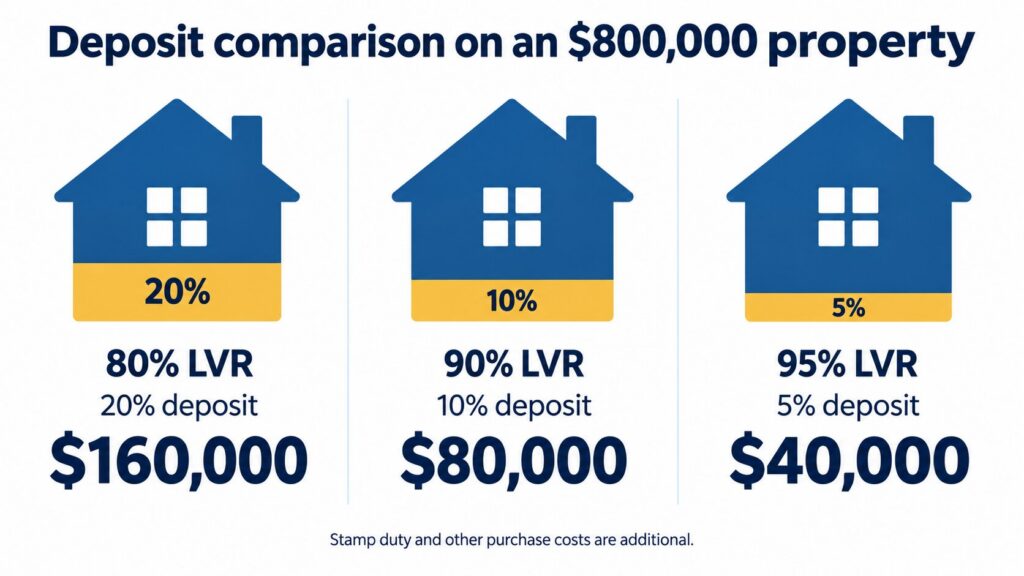
To put the waiver in dollar terms, take an $800,000 purchase. At a standard 80% LVR you need $160,000 in deposit. At 90% LVR under an accounting or legal waiver that drops to $80,000, and at 95% LVR under a medical waiver it is $40,000, with stamp duty and costs on top in each case. Our home loan calculator will show you what repayments look like at each of those loan sizes.
On paperwork, lenders typically ask for evidence of current registration or membership, recent income evidence and identification that confirms citizenship or visa status, though each has its own list. Treat the checklist as a first filter and nothing more. A conversation with a broker is still the most reliable way to confirm where you stand.
FAQ
No. LMI waivers are set by each lender, and ANZ is just one of several banks that publish one. NAB and Westpac both have professional LMI waiver policies of their own, and a handful of non-bank lenders offer comparable no-LMI options for eligible professions. Because the occupation lists, LVR limits and conditions differ from bank to bank, it pays to compare rather than take one lender’s answer as final.
ANZ’s published fact sheets cover accountants with current membership of an eligible institute, lawyers, solicitors, barristers, judges and magistrates holding a current practising certificate, physiotherapists, chiropractors, optometrists and vets, and medical practitioners, dental practitioners and specialists with current AHPRA registration. Nurses, pharmacists and psychologists are specifically listed as ineligible. The list does change from time to time, so always check ANZ’s live fact sheet before relying on it.
On an $800,000 property bought with a 10% deposit, the LMI premium can run to $20,000 or more, and a waiver wipes that cost out entirely. How much you save depends on the loan size, the LVR and the insurer’s pricing at the time. ANZ’s own guide quotes LMI of more than $10,000 on a $500,000 loan with a 10% deposit, so the saving grows with property price.
No. Dark Horse Financial is an independent, credit-licensed finance broker, Credit Representative No. 465325 of Buyers Choice Licencing Pty Ltd (Australian Credit Licence 509484), with no exclusive partnership with ANZ. We access ANZ’s publicly available LMI waiver policy as one option among a large panel of lenders, and we put it up against other lenders’ policies to work out which actually suits the client.
Generally no. A professional LMI waiver is a lender’s own policy, while the Australian Government 5% Deposit Scheme is a government guarantee with its own eligibility rules, and lenders treat the two as separate pathways rather than letting you stack them. A first home buyer in a waiver-eligible profession might qualify for either route, and a broker can help you work out which leaves you better off.
Start by confirming your occupation is on the lender’s current published list and that your registration or membership is current and in a full rather than provisional category. Then check the deposit, property value, ownership share and residency conditions against that lender’s policy. Because these differ from bank to bank, the fastest route to a reliable answer is a broker who can check several lenders in one conversation.
Conclusion
Lenders mortgage insurance is one of the biggest costs of buying with a small deposit, and for eligible professionals it is very often a cost you do not have to wear. ANZ’s published policy takes accounting and legal professionals to 90% LVR and medical and dental practitioners to 95% LVR without the premium, and NAB, Westpac and other panel lenders run their own versions with different occupation lists and conditions attached. The numbers shift, so treat this guide as a starting point and check everything against the lender’s current policy before you act on it.
If you work in an eligible profession and are weighing up a purchase with less than 20% saved, we are happy to run an eligibility check across ANZ and the rest of our panel and show you how the options stack up for your profession, your deposit and the property you have in mind. There is no obligation, and a short conversation is usually enough to tell you where you stand.
Sources and Methodology
This article was reviewed against the lender and government sources listed below. Lender policy figures were taken from each lender’s own published material rather than from third-party summaries. Where a figure could not be confirmed against a primary source, it is flagged in the text. Sources are listed as plain references rather than clickable links.
- ANZ, LMI Waiver Fact Sheet for Professionals (Item No. 97349A series, issued 08.2024): anz.com.au/content/dam/anzcomau/documents/pdf/lmi-waier-fact-sheet.pdf
- ANZ, LMI Waiver for Medical and Dental Practitioners and Specialists (Item No. 97349A, 08.2024): anz.com.au/content/dam/anzcomau/documents/pdf/lmi-waiver-medical-and-dental-practitioners-and-specialists.pdf
- ANZ, LMI Waiver for Accountants (Item No. 97349C, 08.2024): anz.com.au/content/dam/anzcomau/documents/pdf/broker-lmi-waiver-accountants.pdf
- ANZ, Key things you need to know about Lenders Mortgage Insurance (page last modified July 2025): anz.com.au/personal/home-loans/tips-and-guides/key-things-you-need-to-know-about-lenders-mortgage-insurance/
- NAB, LMI waivers for medical and professional services: nab.com.au/personal/home-loans/lmi/lmi-waiver
- Westpac, Home ownership support for healthcare workers (LMI waiver): westpac.com.au/home-loans/healthcare-lmi
- Westpac, Buying your next home (LMI waiver eligibility summary): westpac.com.au/home-loans/next-home
- Australian Government, 5% Deposit Scheme (formerly the Home Guarantee Scheme), expanded 1 October 2025: firsthomebuyers.gov.au and housingaustralia.gov.au
- Semrush keyword data, Australia, August 2026 (search volumes for “LMI waiver” and “ANZ LMI waiver”)
- Canstar, Finder and Eden Emerald Mortgages coverage of professional LMI waiver policies, 2026
Disclaimer: Loans and the benefits associated with them are only available to those who have been approved. The information provided on this page is general and does not consider your individual circumstances. It is not meant to serve as a substitute for professional advice, and you should not rely on it for any decisions. Always consult with a professional regarding finance, tax, and accounting matters before making any choices or taking action.