


Got a tax refund, an inheritance, or a bonus sitting in your account? Putting it straight onto your home loan in Australia is one of the most effective moves a borrower can make, and it can cut years off your loan while you’re at it. What you’re actually allowed to do with that money comes down to your loan type, your lender’s fine print, and what matters most to you financially. Below, we cover how lump sum payments work on an Australian home loan, when lenders will let you make one, roughly what it could save you in interest, and how it stacks up against paying more each month or parking your cash in an offset account instead.
Key Takeaways
- A lump sum payment is an extra, one-off contribution applied directly to your mortgage principal, on top of your regular scheduled repayments.
- Most variable rate home loans in Australia allow unlimited extra repayments, but fixed rate loans usually cap them and may charge a break fee above that cap.
- Pay a lump sum early in your loan term and you'll save more interest than paying the same amount later, because early repayments are weighted more heavily toward interest.
- A lump sum usually shortens your loan term rather than cutting your monthly repayment, unless you ask your lender to recalculate.
- Weigh a lump sum against alternatives, an offset account, other debt, or investing, before you commit the funds.
What Is a Lump Sum Payment on a Mortgage?
Think of it as an extra, unscheduled payment on top of what you already owe each month, applied straight to the loan principal. A normal repayment splits between interest and principal. A lump sum doesn’t split anything: the full amount comes off what you owe, so it’s working for you from day one.
Here’s why that matters. Lenders calculate interest on your outstanding balance, usually daily, based on your current loan balance and rate. Shrink that balance with a lump sum and every future interest calculation starts from a smaller number. Do that over a 30-year loan and the savings compound into real money, something ASIC’s MoneySmart backs up in its own guidance on how home loan interest builds up.
How much you’re able to pay in, and what it nets you, hinges on your loan type and whatever conditions your lender has attached to it.
Can I Make a Lump Sum Payment on My Home Loan?
Most Australian borrowers can. The rules just shift depending on what you’ve signed up for. Variable and fixed rate loans are treated quite differently, so it’s worth a quick call to your lender, or a look through your contract, before you send through anything sizeable. If you’re still shopping around, our guide to home loans in Australia breaks down how different products handle extra repayments.
Variable Rate Loans
Most variable rate home loans in Australia let you make extra repayments whenever you like, fee-free. That’s the norm, not a guarantee though, so don’t assume unlimited access applies to your particular loan until you’ve checked your contract or spoken with your lender.
Fixed Rate Loans
Fixed rate loans typically cap extra repayments at a set amount each year, often somewhere between $10,000 and $30,000, though it varies by lender. Go over that cap, or exit the fixed period early, and a break fee can follow.
A break fee is essentially your lender recovering what it loses when you repay faster than the rate you locked in. These can add up to thousands of dollars, so ask for a written quote before putting a large lump sum onto a fixed rate loan. We won’t quote a break fee figure here since it’s entirely lender-specific and shifts with interest rates. Our guide to making extra repayments walks through how and why extra repayments work across loan types.

How Lump Sum Repayments Reduce Mortgage Interest
Each period, your lender works out interest based on what you still owe. Drop a lump sum onto the loan and that balance falls immediately, which lowers what you’re charged from that point forward.

Take this example:
- Original loan amount: $1,000,000
- Loan term: 30 years
- Lump sum paid after 2 years: $50,000
Run the numbers through a standard amortisation calculation and that $50,000 lump sum saves roughly $204,000 in interest over the life of the loan, while cutting the term by about 3 years and 5 months. This uses an indicative rate of 6.20% p.a., matching the Reserve Bank of Australia’s owner-occupier variable housing rate as at June 2026. Your own numbers will look different depending on your rate, remaining term, and lender’s rules.
Why does timing matter so much? Early in a 30-year loan, most of what you pay each month goes toward interest, not principal. Put a lump sum in during year 3 and it wipes out far more future interest than the same amount would in year 20, purely because there’s more principal, and more time, for the payment to work on.
Can a Lump Sum Payment Reduce Your Mortgage Term?
Yes, as long as you keep making your existing repayments once the balance drops. A smaller principal means more of every future repayment goes toward paying it off, rather than servicing interest.
Most Australian lenders still write new owner-occupier loans over a standard 30-year term, and Australian Bureau of Statistics lending data shows average loan sizes keep growing, which only raises the stakes for an early lump sum. Picture a borrower who makes one payment early in a 30-year loan and simply keeps their repayments the same afterward: they could knock several years off the term just by shrinking how much is left to pay down. The exact number depends on your balance, rate, and how big and how early your payment is, so treat any figure here as a rough guide rather than a promise. Ask your lender to run your specific numbers if you want a firm answer.
Will a Lump Sum Payment Reduce My Monthly Mortgage Repayments?
Not on its own. A lump sum doesn’t touch your regular repayment amount unless you ask for it to. Most people leave their repayments untouched, which means the loan gets paid off earlier and the interest savings build up over what’s left of the term.
Some lenders will recalculate your repayments once the balance drops, so you pay less each period. That sounds appealing, but it can eat into the interest and time savings you’d have banked by leaving your repayments as they were, since less of your future cash goes toward the smaller balance. Ask your lender what’s on offer and think through the trade-off before requesting a recalculation.

Lump Sum Payment vs Increasing Regular Mortgage Repayments
Both cut your principal and shorten your loan term, but they’re built for different situations. A lump sum is a one-off, ideal for a windfall like a bonus or tax refund, and its impact is biggest early in the loan. Raising your regular repayments is more of a long game: a steady, ongoing commitment that tends to work well if your income is climbing over time.
There’s an opportunity cost either way, too. Rather than putting money onto your mortgage, you could invest it, build an emergency buffer, or knock out higher-interest debt first. Which one makes sense depends on your mortgage rate, likely investment returns, how much liquidity you need, and your own circumstances. MoneySmart has guidance on paying off a home loan, and investing isn’t always the better bet, it depends on the borrower. If you want to run your own numbers, try our free home loan offset calculator and compare scenarios side by side.
When Is the Best Time to Make a Lump Sum Mortgage Payment?
The earlier, the better, since a lump sum made sooner has longer to chip away at the interest you’d otherwise pay. Common triggers include:
- A work bonus or commission payment
- A tax refund
- An inheritance or proceeds from selling an asset
- Reaching a savings goal ahead of schedule
Before you transfer anything, check with your lender whether the payment lands against your principal straight away or sits in a buffer account first. That detail changes exactly when your interest reduction kicks in. Even a small amount, applied whenever a windfall lands, adds up over time to a real dent in your total interest bill.
Are Lump Sum Payments Worth It for Australian Home Loans?
For many people, yes. It’s a straightforward way to build equity faster, cut the total interest you pay, and buy yourself more flexibility down the track. The Reserve Bank of Australia has pointed out that plenty of households care a great deal about paying down debt, and ASIC’s MoneySmart makes a similar point: weigh guaranteed interest savings against whatever else matters to you financially.
That doesn’t mean it’s the right call for everyone. Depending on interest rates, your other debts, and your own goals, your money might do more good sitting somewhere else for now. It’s worth reviewing your full financial picture, ideally with a broker or financial adviser, before putting a large sum onto your mortgage.
Lump Sum Payments, Redraw and Offset Accounts
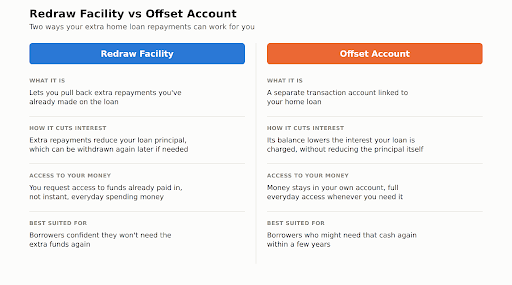
A redraw facility lets you pull back extra repayments you’ve already made. An offset account works differently: it’s a separate transaction account whose balance lowers the interest your loan gets charged, without your money ever leaving your control. Both support a lump sum strategy in their own way, and each fits different needs. Our guide to a mortgage offset account covers the mechanics in more depth.
If keeping access to your money matters, an offset account or redraw facility usually beats paying a lump sum straight off a fixed rate loan, where getting it back out again is much harder. An offset account tends to suit people who might need that cash again within a few years, while a direct lump sum makes more sense if you’re confident you won’t. Either way, check your lender’s rules, fees, and access conditions before you decide.
Final Thoughts
A lump sum payment can be one of the sharpest tools an Australian homeowner has for paying off a mortgage sooner and cutting total interest. Which approach works best for you depends on your loan type, your lender’s conditions, and how the size and timing of your payment line up with what you’re trying to achieve.
If you’re weighing a lump sum against refinancing, restructuring, or other home loan services, the team at Dark Horse Financial can help you compare your options and land on a structure that fits.
Frequently Asked Questions
Usually, yes. Fixed rate loans typically cap extra repayments at a set amount each year, often between $10,000 and $30,000 depending on the lender. Go above that cap, or pay out the loan early, and you can trigger a break fee. Check your loan contract or ask your lender before making a large payment.
Not automatically. Most lenders leave your scheduled repayment unchanged after a lump sum, so your loan term shortens instead while the repayment stays the same. Some lenders will recalculate on request, but that usually cuts into the interest and time savings you’d otherwise get, so weigh up which outcome you actually want.
A lump sum permanently cuts your loan principal and is generally harder to get back unless your loan has a redraw facility. An offset account keeps your money in a separate, accessible account that lowers the interest calculated on your loan without touching the principal.
Variable rate home loans in Australia typically allow extra repayments fee-free, though this varies by lender. Fixed rate loans often charge a break fee once you go over an annual cap. Check your loan contract or contact your lender to confirm what applies to you.
It depends on your loan balance, interest rate, remaining term, and the size and timing of the payment, so there’s no single formula that fits every borrower. ASIC’s MoneySmart mortgage calculator lets you run different lump sum scenarios against your actual loan details for a realistic estimate.
Sources and Methodology
- Australian Securities and Investments Commission, MoneySmart: Pay off your mortgage faster and Mortgage calculator
- Reserve Bank of Australia, Lenders’ Interest Rates, Statistical Table F6, Housing Lending Rates, June 2026
- Australian Bureau of Statistics, Lending Indicators, June Quarter 2026
- The worked example in this article was calculated using a standard principal-and-interest amortisation model based on the loan amount, term, and indicative interest rate stated. Figures are illustrative only and will differ from your actual loan outcome.
Disclaimer: This article is for general informational purposes only and does not constitute financial advice. Dark Horse Financial holds an Australian Credit Licence. Always seek independent financial advice before making decisions about your home loan.
Apply for a Home Loan Today
At Dark Horse Financial, we’re here to help you explore all the options to make the most of your home loan. If you’re considering a lump sum repayment or want to optimise your mortgage structure, get in touch with our team today.