
From 1 July 2025, the general interest charge (GIC) and shortfall interest charge (SIC) the ATO applies to unpaid tax debts are no longer tax deductible, and that’s true no matter which income year the underlying debt relates to. Interest on a business loan taken out to refinance that debt may still be deductible, but only where it meets the general deduction test in section 8-1 of the Income Tax Assessment Act 1997, so it isn’t automatic. That’s why the real comparison between staying with the ATO and refinancing through a lender is an after tax one, not just a side by side of headline rates (see the ATO’s “Changes to deductibility of interest on ATO debts” guidance).
Introduction
More than a year has passed since the ATO interest deductibility change took effect on 1 July 2025, and the gap between the two sides of an ATO debt has only grown clearer since. General interest charge (GIC) and shortfall interest charge (SIC) are now fully non deductible, while interest on a business loan used to refinance that same debt can still be deductible if it meets the ATO’s general purpose test. This page works through what that split actually means for a business weighing its options: a worked cost comparison between the two paths, and a decision framework for judging whether refinancing makes sense for your own circumstances. For the mechanics of the rule change itself, see our FAQs about the ATO interest deductibility change.
Key Takeaways
- GIC and SIC incurred on or after 1 July 2025 aren't deductible, whatever income year the underlying debt relates to.
- The current GIC rate is 11.43% p.a., compounding daily, and SIC for July–September 2026 sits at 7.43% p.a. Both reset quarterly, so check the live ATO rates page before relying on either figure.
- Loan interest deductibility comes down to the general purpose test in section 8-1 of the ITAA 1997, not a blanket rule. Confirm with a tax agent rather than assuming it.
- This is now an after tax comparison, not a headline rate one.
- Refinancing isn't automatically cheaper, since it depends on the loan's rate and term and on whether the funds actually qualify for a deductible purpose.
The Core Trade Off: Non Deductible ATO Interest vs. Potentially Deductible Loan Interest
Since 1 July 2025 the asymmetry here has been stark. Every dollar of GIC or SIC paid to the ATO is now a guaranteed after tax cost with no deduction to soften it, however large the balance grows, while interest on a business loan used to clear that same debt can, given the right circumstances, reduce your taxable income instead.
That test comes from section 8-1 of the ITAA 1997, the general deduction provision, and broadly it says interest is deductible where borrowed funds are used to produce assessable income or for business purposes. Read that as a starting point for a conversation with your tax agent rather than a guarantee your loan automatically qualifies. For how the ATO’s own charge compounds in the meantime, our guide to the Shortfall Interest Charge (SIC) covers the mechanics.
It’s easy to forget this asymmetry is fairly new. Before 1 July 2025 both ATO interest and loan interest were broadly deductible, so the choice between sitting on an ATO debt and refinancing elsewhere came down mostly to rate and cash flow. Now GIC deductibility is off the table entirely, loan deductibility depends on how funds are used, and a same rate comparison between the two doesn’t tell you much on its own.
How Interest Deductibility Actually Works for ATO Debt vs. Business Loans
The ATO side and the loan side don’t run on the same logic at all. One is automatic and date based, with no case by case assessment once the charge is incurred, and the other gets assessed against what the funds were actually used for, so two businesses holding the identical loan product can land in genuinely different places depending on what sits behind it.
Paying down a business tax debt tends to help the case, whether that’s GST, PAYG withholding, or income tax on trading profits. Personal expenses folded into the same loan, or a debt that never really arose from business activity, drag the other way and may need apportioning out. Documentation matters more than most people expect too: lenders and accountants both want a clear paper trail of where the money actually went.
The ATO Side — GIC and SIC Post 1 July 2025
The non deductibility rule applies regardless of the debt’s origin year, so a tax debt from 2019 attracts exactly the same non deductible GIC as one incurred this financial year. One nuance is worth flagging though: interest that accrued before 1 July 2025 remains deductible under the old rules, and that creates a “split” outcome for any debt straddling the cutover date, deductible on one side and not on the other.
The Loan Side — The General Deduction Test
The section 8-1 purpose test asks what the money was actually used for, and refinancing specifically to pay out a business tax debt tends to be viewed more favourably under it. That still isn’t guaranteed though, and it shouldn’t be assumed without your accountant confirming the position against your own facts
Running the Numbers: A Worked Comparison
On a $200,000 ATO debt, non deductible GIC can quietly end up costing more after tax than a comparable business loan, once deductibility actually gets factored into the sum rather than just the headline rate.
Using the current GIC rate of 11.43% p.a. for the ATO side, and an illustrative business loan rate of 9.50% p.a. for comparison, with interest assumed deductible at either a 25% base rate entity or 30% standard company tax rate (check which applies to your business with your accountant), the formula is simple: after tax cost equals interest multiplied by one minus the tax rate where deductible, or the interest in full where it isn’t. The loan rate here is illustrative, not a quote — your actual rate depends on your lender, loan type and risk profile — so use the numbers below as a guide to how the comparison plays out, not a promise about what you’d pay.
Illustrative After Tax Cost: $200,000 ATO Debt Over 12 Months
| Scenario | Nominal Annual Interest | Deductible? | After Tax Rate Used | Effective After Tax Cost |
|---|---|---|---|---|
| Left with the ATO (GIC) | 11.43% p.a. | No | n/a | $22,860 |
| Illustrative business loan* | 9.50% p.a. (example only) | Yes, if the s8-1 test is met | 25%–30% | approx. $13,300–$14,250 |
*Illustrative rate only, not a quote. Actual loan rates depend on the lender, loan type, security and risk profile, so verify with Dark Horse Financial before relying on any figure.
Reading the Table — What Changes the Outcome
Two levers move this outcome most: the loan’s rate and its security or risk profile, and your business’s actual applicable tax rate together with a confirmed deductibility position. Shift either one and the comparison can move substantially.
If daily compounding GIC is already eating into cash flow, it’s worth seeing what refinancing could look like against your own numbers. Dark Horse Financial works with a panel of 100+ lenders and can arrange unsecured ATO tax debt loan options in as little as 24–48 hours.
When Refinancing ATO Debt Into a Loan Makes Strategic Sense
Refinancing tends to make sense once an ATO debt is large enough that daily compounding GIC has genuinely become material, or once the time left on a payment plan is too short for what the business can realistically service. One red flag is worth naming honestly: if something has changed in the business to the point where there isn’t enough revenue to service the debt, whether through a loan over a longer term or a payment plan, that’s the problem to solve first, and refinancing on its own won’t fix it.
The ATO can, in some cases, offer a reduced interest payment arrangement too, but it’s assessed case by case rather than offered as a standard solution, and business owners who explore that path often tell us they’ve been refused reduced interest by the ATO, so confirm current eligibility directly with the ATO or your accountant before relying on it.
Good Fit Indicators
Reasonable turnover, a trading history that supports lender due diligence, and genuine urgency around stopping daily compounding on a sizeable balance all point toward refinancing.
When to Stay on an ATO Payment Plan Instead
A short remaining balance or timeframe, or cash flow too tight for another repayment on top of existing obligations — either is a good enough reason to stay put instead.
Other Factors Beyond Tax Deductibility
Deductibility is just one input here, and it isn’t always the deciding one — cash flow certainty, your standing with the ATO and what you can borrow down the track can easily outweigh it.
A commercial loan gives fixed, certain repayment terms for the life of the facility, whereas an ATO payment plan can be varied or reviewed by the ATO itself, introducing a kind of uncertainty a business loan doesn’t carry. Ongoing ATO debt can also affect your credit profile and your eligibility for future lending or tenders, while removing the ATO as a creditor takes away its broader enforcement powers, which can include measures such as garnishee notices or director penalty notices in some circumstances — raise this with your accountant if it’s a live concern.
Cash Flow and Repayment Certainty
Knowing exactly what you’ll repay, and when, makes forecasting and lender conversations considerably easier than managing a balance the ATO can adjust.
Credit Profile and Future Borrowing Capacity
Once a business tax debt passes $100,000, the ATO can refer it to credit reporting bureaus, and a default lodged against your business credit file reaches well beyond the ATO itself. Unsecured lending becomes effectively unavailable, many asset finance providers will also decline to fund you, and suppliers who spot the default may move your account onto cash on delivery (COD) terms rather than extending credit. Clearing the ATO debt removes that default and supports a stronger credit position going forward.
Making the Decision: A Practical Framework
The choice between an ATO payment plan and a business loan usually comes down to five questions, best worked through with your accountant and a broker together, since this page offers general information rather than individual tax advice.
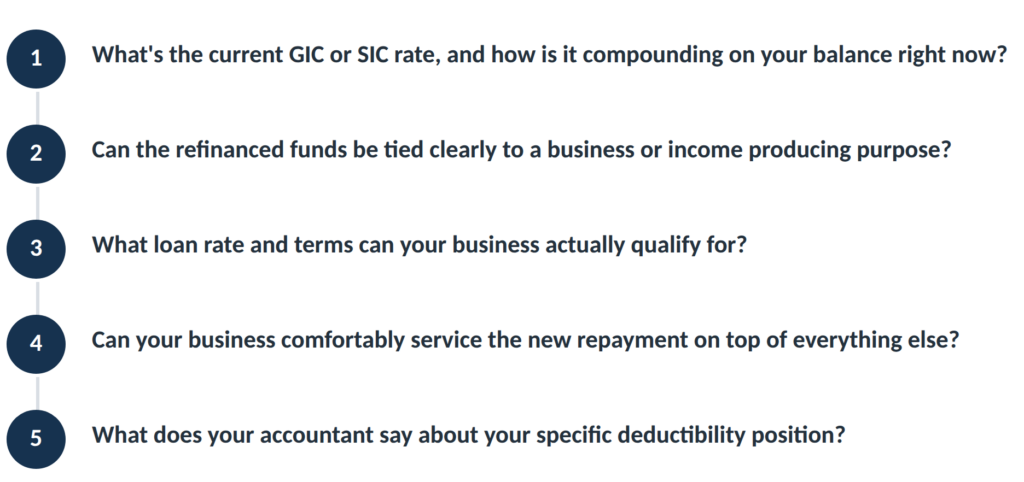
Talk it through and get a clear answer on each point before deciding. This isn’t one to make from the interest rate alone.
Work Through It With Your Accountant First
Your deductibility position needs confirming per business rather than assumed from a general guide. Treat this page as a starting point for that conversation, not a substitute for it.
Frequently Asked Questions
It depends on the after tax cost of each option for your own numbers, so there’s no single answer. GIC currently runs at 11.43% p.a. and isn’t deductible at all, while a business loan’s interest may be deductible if it meets the ATO’s general purpose test, which lowers its effective after tax cost by your business’s tax rate wherever that test is met. That means a loan with a similar or even slightly higher headline rate than GIC can end up cheaper after tax once its interest is deductible, so run the comparison on your own GIC balance, your business’s actual tax rate, and the loan rate you can genuinely secure before assuming either path is cheaper.
No — it’s conditional on meeting the general purpose test in section 8-1 of the ITAA 1997, and that should be confirmed with a tax agent before you rely on it.
There’s no official ATO or lender minimum. It’s less about a fixed figure and more about how material the daily compounding GIC has become on your balance, combined with your own circumstances. Where an ATO payment plan runs over a comparatively short period, the repayment size itself can strain cash flow and make day to day operations difficult, even where the total debt isn’t especially large. Refinancing is worth considering wherever a tax debt loan offers a lower effective rate, or terms that spread repayments over a longer period so they sit more comfortably against the business’s cash flow, rather than at any particular debt size on its own.
Possibly, on an apportioned basis, with the deductible and non deductible portions separated out. That’s worth confirming with a tax agent given how fact specific apportionment can get.
As fast as 24–48 hours on some unsecured products, though full approval timing still depends on the facility type and lender.
Conclusion
“ATO or lender” doesn’t have one answer — it has your answer, and that comes from your numbers, your tax position and your cash flow, not a rule of thumb. What 1 July 2025 changed is the calculus: GIC and SIC are now a guaranteed after tax cost, business loan interest is deductible only conditionally, and the two need running through your own comparison rather than eyeballed against each other. Ready to see what refinancing could look like for your business? Dark Horse Financial’s panel of 100+ lenders can help you explore ATO tax debt loan options, with approval on some unsecured products available in as little as 24–48 hours.
Sources and Methodology
This page draws on the ATO’s “Changes to deductibility of interest on ATO debts” guidance (effective 1 July 2025), the ATO’s General interest charge (GIC) rates page (current rate 11.43% p.a. for the July–September 2026 quarter), and its Shortfall interest charge (SIC) rates page (7.43% p.a. for the same quarter), together with section 8-1 of the Income Tax Assessment Act 1997 (Cth) for the general deductions test.
Disclaimer: This page is general information only. It doesn’t take into account your objectives, financial situation or needs, and it isn’t tax, legal or personal financial advice. Nothing on this page should be relied on as a substitute for advice from a registered tax agent, accountant or licensed financial adviser who can assess your specific circumstances. Interest rates, fees, terms and lending criteria referenced above are indicative only, are set by individual lenders, and can change without notice; your actual rate and terms will depend on the lender, product, security and your risk profile at the time you apply. Dark Horse Financial acts as a finance broker, does not provide tax or legal advice, and approval of any facility remains at the relevant lender’s discretion, subject to their own credit assessment and criteria. Examples and comparisons used in this article are illustrative only and are not a quote, an offer, or a guarantee of the outcome you would receive.
Speak With Dark Horse Financial About Refinancing Your Second Mortgage
We compare solutions across banks, non bank lenders, and specialist lenders to find finance that aligns with your equity position, business performance, and long term goals. Contact our team today to get started on your refinancing plans.