A statutory demand is one of the most serious documents a company director can receive, because if it is not dealt with within 21 days the company can be presumed insolvent and exposed to an application to wind it up. Both Pearce & Heers and Hall & Wilcox identify the Australian Taxation Office (ATO) as one of the most frequent issuers of statutory demands against Australian companies.
This guide walks through the process from start to finish: the demand, the 21-day window, the possible outcomes and the ATO wind up application that can follow. Statutory demands sit within a wider set of ATO debt-recovery tools that includes Director Penalty Notices and garnishee notices, although this article covers the demand and wind-up stages only.
Important: This article is general information only and is not legal advice. If your company has received a statutory demand or is facing a wind-up application, speak to a registered liquidator, insolvency practitioner or lawyer before acting or allowing the 21-day period to pass.
Key Takeaways
- Since 1 July 2021, any creditor owed an undisputed debt of $4,000 or more has been able to serve a statutory demand on a company under s459E of the Corporations Act 2001 (Cth).
- The company then has 21 days from service to pay, settle on terms the creditor agrees to or apply to have the demand set aside, and the Federal Court’s Information Sheet 1 (revised February 2023) is clear that this period cannot be extended.
- Once those 21 days lapse without action, s459C(2) presumes the company is insolvent, and the creditor has three months in which to rely on that presumption in a winding-up application.
- On its “Legal action we may take” page, last updated 5 January 2026, the ATO says it issues statutory demands and will apply to the Federal Court to wind up companies that fail to comply.
- Pearce & Heers puts the number of ATO winding-up applications in the 2015 financial year at over 1,000, which is a dated figure and best treated as illustrative.
- Even after a demand lapses the company is not in liquidation until a court makes an order, and there are still steps that can be taken before then.

What Is a Statutory Demand?
A statutory demand is a creditor’s formal written demand under s459E of the Corporations Act 2001 requiring a company to pay a debt, or reach an arrangement the creditor accepts, within 21 days of service. It is the usual first step before a creditor applies to have a company wound up in insolvency.
Any creditor can issue one, not only the ATO. The debt must total at least $4,000 and be due and payable rather than disputed. The demand must be in writing in the prescribed form (Form 509H), specify the debt and its amount, and be signed by or for the creditor, and where the debt is not a judgment debt it must be accompanied by an affidavit verifying it.
A demand is usually served by leaving it at, or posting it to, the company’s registered office, which is one reason keeping those details current with ASIC matters. Clayton Utz also noted in November 2022 that service of a set-aside application can be effected by email, so directors should treat any properly delivered document seriously whatever its format.
A statutory demand differs from an ordinary letter of demand, which has no automatic legal consequence, and from a bankruptcy notice, which applies to individuals rather than companies.
How Long Do You Have to Respond to a Statutory Demand?
A company has 21 days to respond to a statutory demand. The 21 days start on the date the demand is served on the company, not the date a director opens or reads it. If the demand is sent by post, the Federal Court notes it is generally treated as served seven working days after it was posted, unless there is evidence showing otherwise.
Within those 21 days, the company has two options:
- Pay the debt in full, or agree a payment arrangement that the creditor accepts.
- Apply to the Federal Court or a state Supreme Court under s459G to have the demand set aside.
The courts apply this deadline strictly. According to the Federal Court’s Information Sheet 1, no extension of time is available, so a company that misses the deadline cannot ask the court for more time.
Example: how the 21 days are counted
The following is a hypothetical example to show how the deadline works in practice.
- A creditor leaves a statutory demand at a company’s registered office on Monday 2 November 2026. This is the date of service.
- The 21 days are counted from the following day, so the deadline is Monday 23 November 2026.
- By the end of that day, the company must have either paid or agreed terms with the creditor, or filed a set-aside application with the court and served a copy on the creditor.
Beginning the process is not enough. If the application is still being prepared on 23 November, even with a lawyer engaged, the deadline has not been met.
What Happens if a Statutory Demand Is Ignored or Lapses?
If the 21 days pass without compliance or a set-aside application, s459C(2) of the Corporations Act creates a presumption of insolvency. At any later winding-up hearing the court must presume the company is insolvent unless it proves otherwise, which places the practical burden on the company and its directors.
The creditor then has three months from non-compliance to file a winding-up application. A lapsed demand does not by itself put the company into liquidation, as a court order is still required and the company can appear at the hearing.
Directors who keep trading during this period also face separate duties under the Corporations Act not to incur debts while the company is insolvent. Insolvent trading is outside the scope of this article, but ASIC’s insolvency guidance for directors is a useful starting point.
How Does the ATO Use Statutory Demands to Recover Tax Debt?
The ATO states on its “Legal action we may take” page that it can issue a statutory demand to a company that has not paid its debts, requiring it “to pay the entire debt or enter into a payment plan with us within 21 days.” If the company does not comply, the ATO says it may treat the non-payment as evidence of insolvency and apply to the Federal Court to wind the company up.
This sits alongside other firmer actions such as garnishee notices and Director Penalty Notices. The ATO also makes clear that legal action is generally directed at taxpayers who have not paid and have not engaged, and it encourages anyone unable to pay to contact it or their tax professional as early as possible.
The ATO’s stance has firmed since the pandemic, and its media release of 13 May 2022, “ATO prioritising support and assistance for debt collection efforts”, marked a return to more active collection after the leniency of 2020 and 2021. Historically the ATO has also been the most frequent applicant for company wind-ups, with Pearce & Heers citing more than 1,000 applications in the 2015 financial year, a figure useful as context rather than as a current statistic.
None of this means a wind-up is automatic or guaranteed in any individual case.
Can a Statutory Demand Be Set Aside, and What Are the Real Options at Each Stage?
There are two main legal grounds. Under s459H, the court may set aside a demand where there is a genuine dispute about the debt or the company has an offsetting claim. Under s459J, it may do so where a defect in the demand would cause substantial injustice, or for some other reason. In either case the application must be filed and served within the 21 days, and legal representation is normally needed.
Outside those grounds, the practical option is to negotiate with the creditor, including the ATO, for full payment or a payment arrangement before the 21 days expire.
If a winding-up application has been filed, the company can still oppose it, appoint a voluntary administrator, or pursue Small Business Restructuring under Part 5.3B as an alternative to liquidation.
Sometimes the problem underneath a demand is a tax debt that is real but manageable, and in that situation refinancing can deal with it before matters escalate. If ATO debt is part of what is driving a statutory demand, tax debt loans may be a way to clear it before the 21-day window becomes a larger problem. As a commercial finance broker, Dark Horse Financial cannot stop legal action or guarantee any outcome, but we can assess whether finance is realistic alongside the advice of your insolvency practitioner or lawyer.
What Should a Director Do if They Receive a Statutory Demand from the ATO?
Do not ignore the demand. The company has only 21 days to respond, and that period started on the date the demand was served, not the date you first saw it. Once you have it in hand, the following steps are usually worth taking:
- Seek advice immediately from a registered liquidator, insolvency practitioner or lawyer, given how strictly the deadline is applied.
- Confirm the amount is actually owed and not in dispute, because a set-aside application depends on there being a real ground for one.
- Contact the ATO directly if a payment arrangement is realistic, since its own guidance states it prefers engagement to legal action. Our guide to the ATO payment plan explains eligibility and what to do if you do not qualify.
The underlying cash-flow problem can sometimes be solved with finance rather than an insolvency process, and where the business remains viable it is worth raising tax debt refinancing with your adviser.
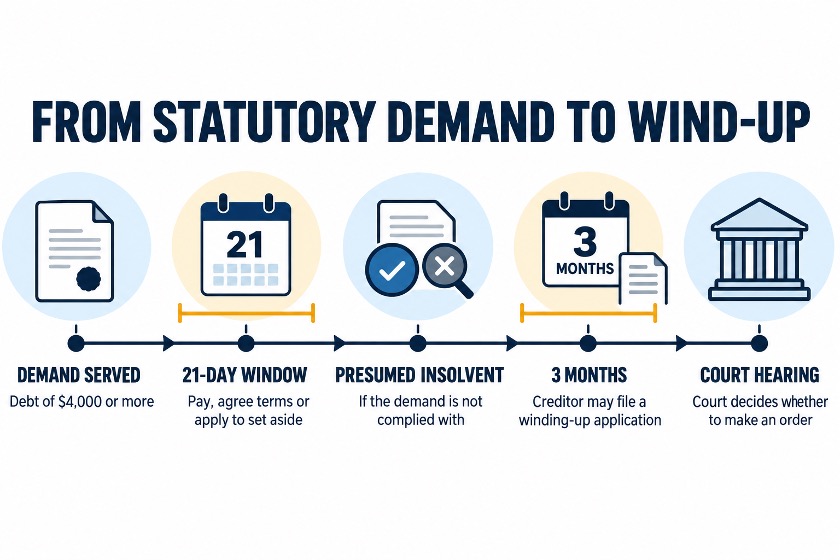
The Statutory Demand to Wind-Up Timeline
- Demand served: the creditor serves a written demand under s459E for a debt of $4,000 or more that is due and payable.
- 21-day window: time starts on the date of service.
- Pay or challenge: the company either pays or agrees terms with the creditor, which brings the process to an end, or files an application under s459G to set the demand aside, in which case the court decides.
- Presumption of insolvency: if the company does neither, s459C presumes it insolvent when the 21 days run out.
- Winding-up application: any creditor relying on the demand, the ATO included, has three months to file.
- Hearing: the court can make a winding-up order and appoint a liquidator, although the order is avoided if the debt has been paid, an administrator or restructuring practitioner has been appointed, or the application is dismissed.
What can you do at each stage?
| Stage | Time left | What you can still do | Who to involve |
|---|---|---|---|
| Before a demand is issued | No formal deadline | Engage with the ATO, arrange a payment plan or refinance the debt | Accountant, tax agent, finance broker |
| Within the 21-day window | Up to 21 days from service | Pay, agree an arrangement or apply to set the demand aside | Lawyer or insolvency practitioner |
| After 21 days, before a wind-up application | Up to three months for the creditor to file | Negotiate payment, gather evidence of solvency, consider administration or restructuring | Registered liquidator, lawyer |
| Once a wind-up application is filed | Until the hearing | Pay the debt, oppose the application, appoint an administrator or begin restructuring | Lawyer, registered liquidator |
Conclusion
Statutory demands run on fixed deadlines that courts enforce strictly, so advice tailored to your company will always matter more than a general guide like this one. Directors who act in the first few days of the 21-day period have far more choices available to them than those who wait.
Where the cause is a genuine tax or cash-flow debt the business can resolve, finance may help ensure it does not end in a wind-up application. Dark Horse Financial helps business owners assess whether tax debt loans or other commercial finance could clear the underlying debt, matching the business to a lender with the right policy fit from a large panel of lenders. To discuss your situation, speak with the team.
Reminder: This article is general information only and is not legal advice. Speak to a registered liquidator or insolvency practitioner before acting or allowing the 21-day period to lapse.
Frequently Asked Questions
The minimum is $4,000, which has applied since 1 July 2021 when the threshold permanently increased from $2,000. During COVID-19 it was temporarily raised to $20,000 before reverting. The debt must also be due, payable and not genuinely disputed.
A company has 21 days from the date of service, not the date the demand is opened. Courts apply this period strictly and cannot extend it, and any set-aside application must be filed and served within the same 21 days.
The company is presumed insolvent under s459C of the Corporations Act. The creditor can then rely on that presumption to file a winding-up application within three months, and the company carries the burden of proving it is solvent.
Yes. The ATO states that it can issue a statutory demand to a company and, if the company does not comply, apply to the Federal Court to wind it up. It uses the same statutory demand and court process as any other creditor.
Options remain, including paying the debt, negotiating, opposing the application, voluntary administration or Small Business Restructuring, but they become harder to use as the hearing approaches. This is general information only, so obtain professional advice for your situation.
Not on its own. If a demand goes unanswered the law presumes the company is insolvent, but that presumption can be rebutted, for example with financial records showing the company is able to pay its debts as and when they fall due.

Sources and Methodology
This article draws on primary sources from the Federal Court of Australia and the ATO, supported by published commentary from Australian insolvency and legal firms. Sources were accessed in October 2026.
- Federal Court of Australia, Corporations Information Sheet 1: Winding up proceedings based on an unsatisfied Statutory Demand (revised 2 February 2023)
- Australian Taxation Office, Legal action we may take (last updated 5 January 2026)
- Australian Taxation Office, Firmer action we may take
- Australian Taxation Office, ATO prioritising support and assistance for debt collection efforts, media release, 13 May 2022
- Pearce & Heers, Statutory Demands: 21-Day Rule Explained
- Hall & Wilcox, ATO statutory demands, winding up applications and liquidation (10 March 2021); Newsflash: threshold for statutory demands raised
- Kells the Lawyers, Statutory minimum has permanently increased for statutory demands (13 August 2021)
- Clayton Utz, Signed, sealed, emailed: service by electronic communication and setting aside statutory demands (30 November 2022)
- ASIC, Insolvency information for directors
- Corporations Act 2001 (Cth), ss459C, 459E, 459G, 459H, 459J and Part 5.3B
Disclaimer
This article contains general information only and does not constitute legal, financial or tax advice, and it does not take your company’s circumstances into account. If your company has received a statutory demand or is facing a winding-up application, speak to a registered liquidator or insolvency practitioner before acting or allowing the 21-day period to lapse. Dark Horse Financial is a commercial finance broker and cannot stop legal action or guarantee any outcome. Dark Horse Financial Pty Ltd is a Credit Representative No. 465 325 of Buyers Choice Licencing Pty Ltd.