
When a bank has declined your business loan application it is frustrating, but it is rarely the final word on whether your business can be funded. A bank decline usually reflects that bank’s credit policy and appetite at the time, not the strength of your business, and non-bank and private lenders assess cash flow, assets and exit strategy quite differently, which is why business loans when banks say no are often still very achievable.
Key Takeaways
- A bank decline reflects one lender's credit policy, it is not a final verdict on whether your business is fundable.
- Non-bank and private lenders place more weight on cash flow, security and exit strategy than on a perfect history.
- Non-bank business lenders are usually faster and more flexible, and many have pricing similar to a bank.
- If you take on higher-cost funding to solve an urgent problem, plan your pathway back to cheaper finance.
- A broker who understands lender policy can match your application to the right lender the first time.
Common Reasons Banks Decline Business Loans
Every bank lends inside a credit policy that is set by head office and that policy usually gets tighter, not looser, when the economy slows. In our experience a business loan declined by a bank most often comes back to one of the following:
- Short trading history. Many banks prefer at least two years of trading and lodged financials, so a newer business can be declined regardless of how well it is actually performing.
- ATO debt or late BAS. An outstanding tax debt or a history of late lodgements is read as a sign of cash flow pressure, although specialist tax debt loans are designed for exactly this situation.
- Past defaults or credit file issues. Defaults, court judgments and a high number of recent enquiries can all lead to an automatic decline.
- Irregular or seasonal income. Revenue that moves significantly from month to month doesn’t sit neatly within a bank’s servicing calculations, even when the annual figures are healthy.
- An industry the bank avoids. Construction, hospitality and certain other sectors are often classed as higher risk and given less appetite.
- Not enough security. Banks commonly expect property security for larger facilities and a business without it may be offered a much smaller limit, or nothing at all.
- Complex structures. Trusts, multiple entities and intercompany loans take longer to assess and frequently fall outside a bank’s standard process.
- Speed. Sometimes the bank simply cannot meet the deadline, and a supplier payment, equipment purchase or settlement date will not wait six to eight weeks for an answer.
None of these reasons necessarily mean your business is a poor credit risk, they mean the bank’s policy did not fit your circumstances at that point in time.
Ask Why and Get It in Writing
Before you do anything else, ask the bank to explain the specific reason for the decline and, where possible, to confirm it in writing. A general response such as “it doesn’t meet our criteria” is of limited use, whereas knowing whether the issue was trading history, a credit file entry or the level of security tells you exactly which type of lender to approach next.
It is also worth obtaining a copy of your credit report from the credit reporting bodies (Equifax, Experian and illion), which you can access free of charge every three months, and checking it for errors such as defaults that have been paid or that do not belong to you. Incorrect listings can be disputed and corrected.
Most importantly, resist the urge to reapply immediately with several other lenders. Each application usually records an enquiry on your credit file and a cluster of enquiries in a short period tends to make the next lender more cautious, not less.
How Non-Bank Lenders Assess Differently
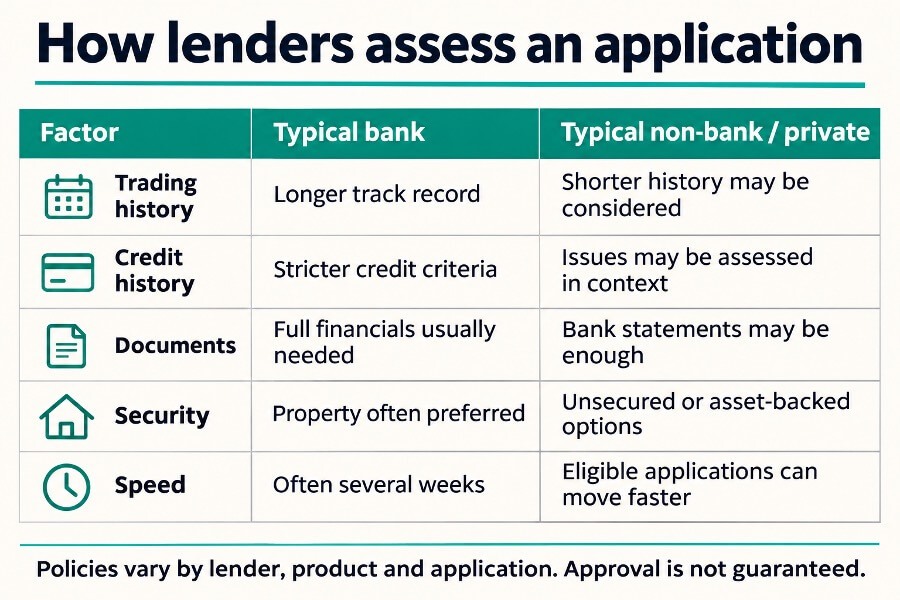
Non-bank lenders and private financiers are not bound by the same credit policies as the major banks. Many fund their lending through institutional investors rather than customer deposits, which gives them more room to consider the whole picture, including how the business is performing now and not only how it looked in last year’s tax return. Our guide to banks vs non-bank lenders covers the broader differences in more detail.
| Factor | Typical bank approach | Typical non-bank or private approach |
| Trading history | Usually two years or more, with lodged financials | Some lenders consider businesses trading for as little as three months, with more options after 12 months |
| Credit history | Defaults and judgments commonly result in a decline | Considered in context, and some private lenders place little or no weight on the credit file |
| Documentation | Full financials, tax returns, BAS and management accounts | Unsecured lending up to around $1 million can be assessed on business bank statements alone |
| Security | Property security often expected for larger limits | Unsecured, asset-backed, second mortgage and caveat options depending on the need |
| Speed | Several weeks, and six to eight weeks is not unusual | Approval within 24 to 48 hours on eligible unsecured products |
This comparison is directional rather than absolute. Every lender has its own policy and the right fit depends on the amount, the purpose of the funds and what your business can demonstrate.
Your Options After a Bank Decline
There is no single alternative to a bank, instead there is a range of business loans built for different circumstances. The right option depends on what the funds are for, what security is available and how the loan will be repaid.
Unsecured Non-Bank Loans
Unsecured business loans from non-bank lenders are assessed mainly on cash flow, with the lender reviewing a read-only view of your business bank statements rather than requesting full financials. They suit trading businesses needing working capital, stock or funds to cover a temporary gap, generally up to around $1 million, and approval can be fast. A director’s guarantee is standard and most lenders also take a General Security Agreement over the business.
Secured or Asset-Backed Loans
Where the business owns equipment, vehicles or other assets, an asset-backed loan can unlock funding the bank would not provide, with the security strengthening an application where the credit history or trading figures are less than perfect. This option tends to suit larger amounts and businesses with a solid asset base but a less conventional financial story.
Private Lending, Caveat Loans and Second Mortgages
Private lending secured against property is usually the most flexible option, and many lenders offering caveat loans do not review the credit file at all. The deciding factors are the strength of the security and a credible exit strategy, meaning a clear plan for how the loan will be repaid, whether through a sale, a refinance or expected incoming funds. These facilities are typically short term and suited to urgent or time-sensitive needs.
Invoice Finance
If your business invoices other businesses on terms of 30 days or longer, invoice finance allows you to bring your cash recognition forward by advancing funds against outstanding invoices. Because the facility grows with your sales and is supported by your debtors, it suits B2B businesses such as transport, labour hire and manufacturing that are waiting on payment while payroll and running costs fall due.
The Trade-Off: Cost, Speed and Flexibility
Non-bank and private finance can cost more than a bank loan. Some non-bank lenders are considerably more expensive than banks, and fees can form part of the overall cost as well. Lenders who accept more risk, move faster or require less documentation price that into the facility.
That does not make it the wrong decision. If higher-cost finance solves an urgent problem, such as clearing an ATO debt, securing a contract or covering payroll through a slow period, the cost of not acting can be far greater than the interest. A business that misses an opportunity or damages its supplier relationships pays for that as well, only in a less visible way.
Higher-cost finance works best as a step rather than a destination. So before you sign, have a plan for getting back to cheaper finance, whether that means refinancing to a bank or a lower-cost non-bank facility once there is more trading history behind the business, once the credit file has improved or once the ATO debt has been cleared. It also pays to ask the lender about early repayment terms up front so the cost of refinancing later is not a surprise.

How a Broker Changes the Outcome
A bank decline is often less about the business itself and more about how the application was presented and where it was sent. At Dark Horse Financial we begin with a detailed conversation about your business, its cash flow cycle and anything likely to concern a lender, and we do not run a credit check at enquiry stage, so your credit file is protected while we identify the right fit.
From there we prepare the application to tell the right story, addressing lender concerns upfront rather than leaving the credit team to discover them, and match it to the one lender whose policy suits your circumstances from a large panel of bank, non-bank and private lenders.
Timing matters as well. One client, a profitable business of close to 100 employees, approached us from a position of strength and we secured a $1.5M unsecured overdraft with rates and fees better than many bank clients receive on property-secured overdrafts. They have never needed to draw on it, but it is there as a safety net if conditions change, and it was available on those terms because they applied before they needed it.
Conclusion
A business loan declined by the bank is a setback, not a dead end. Find out the specific reason, check your credit file and avoid submitting multiple applications at once. Non-bank and alternative business lenders assess cash flow, assets and exit strategy differently, so a business the bank turned away is often still fundable through the right lender, provided the cost and the repayment plan make sense. If your bank has said no, or you want to avoid that outcome next time, talk to a broker at Dark Horse Financial about the options that suit your business.
FAQs
A bank will usually refuse a business loan because the application does not fit its credit policy, rather than because the business cannot repay. The most common triggers are a short trading history, ATO debt or late BAS lodgements, defaults on the credit file, irregular income, an industry the bank sees as higher risk, not enough property security and complex business structures. Other lenders may still approve the same business.
A bank decline is not recorded on your credit report as a decline, however the business loan application is usually recorded as a credit enquiry. Several enquiries within a short period can lower your credit score and make other lenders more cautious. Finding out why the bank declined the business loan before applying elsewhere helps protect your credit file from unnecessary enquiries.
You can get a business loan with ATO debt, even when a bank has declined the application. Some non-bank and private lenders offer tax debt loans designed to clear an outstanding ATO balance, assessing the business on its cash flow, security and repayment plan. Approval depends on the size of the tax debt, whether any payment arrangements are being met and the business’s current trading position.
Many non-bank lenders are established, well-funded businesses that have lent to Australian businesses for many years, and lenders offering consumer credit must hold an Australian Credit Licence. Before accepting a business loan from a non-bank lender, check who you are dealing with, including the lender’s company details, how long it has operated and whether it is a member of the Australian Financial Complaints Authority (AFCA).
A non-bank lender can approve a business loan within 24 to 48 hours on eligible unsecured products, and some lenders can assess, approve and fund on the same day. Timeframes depend on the product, the loan amount and how quickly documents are supplied. Secured facilities, larger limits and loans requiring full financials generally take longer than an unsecured loan assessed on bank statements.
Sources and Methodology
This article draws on Dark Horse Financial’s experience arranging finance for more than 1,000 Australian businesses over more than 10 years, together with general guidance on credit reports from ASIC’s Moneysmart and on complaint handling from the Australian Financial Complaints Authority (AFCA). Lender policies, assessment criteria and timeframes change regularly and vary between lenders.
Disclaimer
The information in this article is general in nature and does not take into account your objectives, financial situation or needs. You should consider whether it is appropriate for your circumstances and seek professional advice before making any financial decision. Dark Horse Financial Pty Ltd is a Credit Representative No. 465 325 of Buyers Choice Licencing Pty Ltd.