

Learning that your company may be heading into voluntary administration is a stressful position for any director. It is important to understand, however, that voluntary administration is not the same as liquidation. It is a temporary process in which an independent registered liquidator takes control of the company to work out the best path forward.
This guide explains what triggers the voluntary administration process in Australia, what happens once an administrator is appointed, the two creditors’ meetings and their timeframes, and the three possible outcomes.
This article is general information only and is not legal advice. If you are considering or facing voluntary administration, speak to a registered liquidator or insolvency practitioner about your circumstances.
Key Takeaways
- Voluntary administration is a temporary process designed to resolve a company's future, and liquidation is only one of three possible outcomes.
- Directors most commonly start the process by appointing an administrator through a written board resolution.
- The first creditors' meeting must be held within 8 business days of the administration beginning (ASIC INFO 74, viewed October 2026).
- A statutory moratorium generally stops unsecured creditors from pursuing the company while the administration is underway.
- Creditors decide the company's future at the second meeting, which ASIC indicates is usually held about five weeks after the appointment.

The Voluntary Administration Timeline, Step by Step
The table below sets out the main statutory steps in order, and while the court has the power to extend some of these timeframes, they are the standard position most administrations follow.
| Step | Trigger | Statutory Timeframe |
|---|---|---|
| 1. Appointment | Directors, a liquidator or provisional liquidator, or a secured creditor appoints a registered liquidator as administrator | Administration begins on appointment |
| 2. Moratorium | Unsecured creditors are generally stayed from suing, enforcing debts or recovering property without consent or court leave | Immediately, for the whole administration |
| 3. Secured creditor decision period | A secured creditor over the whole, or substantially the whole, of the company’s property decides whether to enforce | 13 business days (s 441A) |
| 4. First creditors’ meeting | Creditors confirm or replace the administrator and may form a committee of inspection | Within 8 business days (s 436E) |
| 5. Investigation and report | The administrator reports to creditors with a recommendation | Before the second meeting |
| 6. Second creditors’ meeting | Creditors vote on the company’s future | Convening period of 20 business days, or 25 over Christmas or Easter (s 439A); meeting held within 5 business days of its end |
| 7. Outcome | DOCA executed, control returned to directors, or company wound up | A DOCA must be signed within 15 business days of the meeting |
What Triggers Voluntary Administration?
Voluntary administration is triggered by an appointment rather than a court order, and in most cases it is the company’s own directors who act once they conclude the company is insolvent or likely to become so.
The most common route is a written board resolution appointing an administrator under s 436A of the Corporations Act 2001 (Cth). A liquidator or provisional liquidator already appointed to the company can also appoint an administrator in some circumstances, as can a secured creditor holding security over the whole, or substantially the whole, of the company’s property.
Directors often act early because the appointment hands control to an independent professional and can protect them from some, though not all, forms of personal liability that keep accruing while an insolvent company trades on, but this is a legal question outside Dark Horse’s role and directors should get their own advice.
Only a registered liquidator, as defined and regulated by ASIC, can act as an administrator.
What Happens Once an Administrator Is Appointed? The Moratorium Explained
Once an administrator is appointed, a statutory moratorium generally freezes creditor action so the administrator can assess the company’s position without the business being dismantled piece by piece.
Unsecured creditors generally cannot begin, continue or enforce proceedings against the company, and owners or lessors of property it uses generally cannot recover that property, without the administrator’s written consent or the court’s permission. The key exception is a secured creditor holding security over the whole, or substantially the whole, of the company’s property, which has a 13 business day “decision period” to enforce its security instead of letting the administration proceed.
Personal guarantees need particular attention. During the administration a creditor generally cannot act on a director’s guarantee without the court’s permission, but that protection ends with the administration and ASIC notes a DOCA does not stop a creditor pursuing a guarantor. Director Penalty Notices from the ATO operate separately again.
Throughout this period the administrator, not the directors, controls the company’s affairs, property and business. How the moratorium applies to any particular creditor or guarantee depends on the facts and is a matter for a lawyer or registered liquidator.
The First Creditors' Meeting: What Happens and When
The first creditors’ meeting must be held within 8 business days of the administration beginning (s 436E, Corporations Act 2001 (Cth)), and it exists mainly so creditors can confirm or replace the administrator, not to decide the company’s fate.
Creditors vote on whether to keep the current administrator or appoint another registered liquidator, and whether to form a committee of inspection to work with the administrator and approve certain matters such as fees. To vote, a creditor generally needs to lodge a proof of debt beforehand.
As an example, if an administration begins on a Monday, the first meeting must be held by the Thursday of the following week (assuming no public holidays), giving creditors an early checkpoint on who is running the process.
The Second Creditors' Meeting: The Convening Period and What's Decided
The second creditors’ meeting is where creditors actually decide the company’s future.
Under s 439A of the Corporations Act 2001 (Cth), the administrator must convene this meeting within a convening period of 20 business days from the business day after the administration begins, extended to 25 business days where the administration begins in December or shortly before Easter, and the meeting must then be held within five business days of the period ending. ASIC indicates the meeting is usually held about five weeks after appointment. The court can extend the convening period in complex cases, but that is the exception.
Beforehand, the administrator must give creditors a report on the company’s business, property, affairs and financial circumstances, with an opinion on each of the three possible outcomes and a recommendation. Creditors then vote, generally by a majority in both number and value, with the chair holding a casting vote in some circumstances.
For directors, this is the meeting that warrants the most preparation.
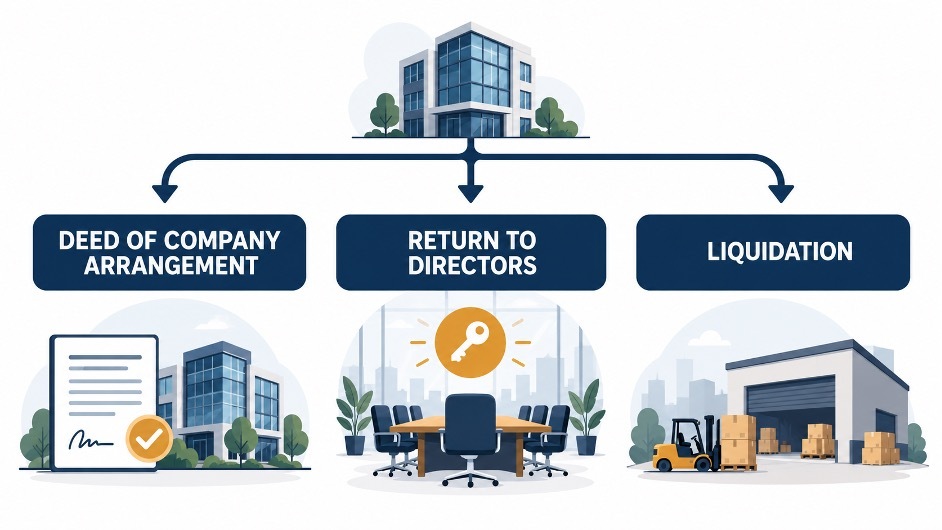
The Three Possible Outcomes: DOCA, Return to Directors, or Liquidation
Creditors at the second meeting have three options, and the choice fundamentally changes what happens to the company next.
The first is a Deed of Company Arrangement (DOCA), a binding agreement between the company and its creditors that usually involves a compromise of debts and a structured repayment or restructuring plan, and that allows the company to keep trading. The deed must be signed within 15 business days of the meeting and binds all unsecured creditors, including those who voted against it.
The second is ending the administration and returning the company to its directors, which generally happens only where creditors conclude the company was never insolvent or its position has since been resolved.
The third is winding the company up. The administration converts into a creditors’ voluntary liquidation, and a liquidator, usually the administrator, realises the company’s assets and distributes the proceeds in the statutory order of priority.
Dark Horse is a finance broker and has no role in, and cannot influence, which outcome creditors choose.
| Outcome | What It Means | Typical Result for the Company | Typical Result for Creditors |
|---|---|---|---|
| DOCA | A binding deed compromising or restructuring the company’s debts | Continues trading under the deed | Paid in full or in part under the deed’s terms |
| Return to directors | The administration ends and control returns to the board | Resumes normal operations | Remain owed their debts on the original terms |
| Liquidation | The company is wound up and its assets sold | Ceases trading and is eventually deregistered | Paid from asset sale proceeds in the statutory order of priority |
Talk to Dark Horse Before or Alongside Formal Advice
If ATO debt is part of the pressure your company is under, finance arranged to address that debt may be worth exploring as one option alongside proper insolvency advice, not in place of it. A conversation with Dark Horse costs nothing and carries no obligation, so you are welcome to speak with our team.
What Does Voluntary Administration Mean for Directors, Employees and the Business?
The moment an administrator is appointed, control of the company changes hands, yet that on its own does not mean staff will lose their jobs or that the business is finished, since so much rests on the decision creditors make at the second meeting.
From the date of appointment the directors’ powers are suspended, so a director cannot act for the company unless the administrator consents, though directors are still expected to help the administrator and hand over the company’s books and records along with a report on its activities and property.
If the business continues to trade through the administration, employees will generally stay employed and keep being paid, although that depends on the administrator’s view of how much cash the company actually has available. Should the company go on to be liquidated, unpaid wages, superannuation and similar entitlements rank ahead of most other unsecured debts in the statutory priority order, which is a general point and not advice about any individual’s position.
A company that emerges through a DOCA will typically keep trading under its existing structure, subject to the deed’s terms.
Not every company under pressure has an unviable business. Where the underlying problem is cash flow or a build-up of tax debt, arranging finance, including tax debt loans directed at ATO debt, can sometimes form part of resolving the position before or alongside a formal insolvency process.
Conclusion
Voluntary administration is a structured process with an outcome that is not decided in advance. It is not an automatic end to the company, and depending on what creditors decide, the business may continue under a DOCA, return to its directors or be wound up.
This article is general information only and is not legal advice. Please speak to a registered liquidator or insolvency practitioner about your situation, and to a lawyer as well where a personal guarantee or Director Penalty Notice is involved.
If cash flow or ATO debt is part of the pressure on your business and you would like to discuss your finance options, please get in touch with the Dark Horse team.

Frequently Asked Questions
No. Voluntary administration is a temporary process in which an independent administrator takes control of a company to determine the best outcome for its future. Liquidation is one of three possible outcomes, alongside a Deed of Company Arrangement or a return to the directors, and creditors decide which applies at the second meeting.
The first creditors’ meeting must be held within 8 business days of appointment. The second meeting is convened within 20 business days (25 over Christmas or Easter) and held within five business days of that period ending, usually about five weeks after appointment. A DOCA can extend the company’s involvement well beyond this.
Most commonly, the company’s directors appoint an administrator by board resolution. A liquidator or provisional liquidator of the company can also make the appointment, as can a secured creditor holding security over the whole, or substantially the whole, of the company’s property. The administrator must be a registered liquidator.
Generally not. A statutory moratorium prevents unsecured creditors from starting or continuing claims without the administrator’s consent or the court’s permission. The main exception is a secured creditor over the whole, or substantially the whole, of the company’s property, which has a 13 business day decision period to enforce. Guarantee protection ends with the administration.
A Deed of Company Arrangement is a binding agreement between a company and its creditors, approved at the second creditors’ meeting. It usually involves a compromise of debts and a structured repayment or restructuring plan that allows the company to keep trading. A DOCA binds all unsecured creditors, including those who voted against it.
Where the business keeps trading, employees generally remain employed and paid during the administration, subject to the administrator’s view of the company’s cash position. If the company is later wound up, entitlements such as unpaid wages and superannuation receive priority over most other unsecured debts under the statutory order of priority.
Sources and Methodology
This article draws on the sources below, reviewed in October 2026. Statutory timeframes were cross-checked against both ASIC and Worrells.
- ASIC, Information Sheet 74: Voluntary administration: A guide for creditors. asic.gov.au/regulatory-resources/insolvency/insolvency-for-creditors/voluntary-administration-a-guide-for-creditors
- Worrells, Meeting convening periods (corporate). worrells.net.au/resources/knowledge/meeting-convening-periods-corporate
- Corporations Act 2001 (Cth), Part 5.3A, including ss 436A, 436E, 439A and 441A. legislation.gov.au
Disclaimer
This article is general information only and is not legal, financial or insolvency advice. It does not take into account your company’s objectives, financial situation or needs. If you are a director considering or facing voluntary administration, please speak to a registered liquidator or insolvency practitioner about your specific situation, and to a lawyer as well where a personal guarantee or Director Penalty Notice is involved. Dark Horse Financial Pty Ltd is a Credit Representative No. 465 325 of Buyers Choice Licencing Pty Ltd.