If you are the director of a company carrying a significant ATO debt, there is a good chance you are already weighing up your options and trying to work out what to do before the situation escalates any further. Small business restructuring (SBR) is a formal process built specifically for smaller companies and, unlike voluntary administration, it lets the director stay in charge of day-to-day trading while a plan is put to creditors.
The ATO is very often the largest creditor voting on these plans, so it matters how the process treats tax debt in particular. This article covers eligibility, the SBR process and its statutory timeframes, how the ATO approaches restructuring plans, and how SBR compares with voluntary administration and liquidation.
Key Takeaways
- Small business restructuring is a formal insolvency process under Part 5.3B of the Corporations Act 2001 (Cth), and the director keeps control of the company while a plan to restructure its debts is put to creditors.
- Eligibility requires total liabilities of no more than $1 million, employee entitlements paid and tax lodgements up to date before the plan is issued, plus a seven-year clean history.
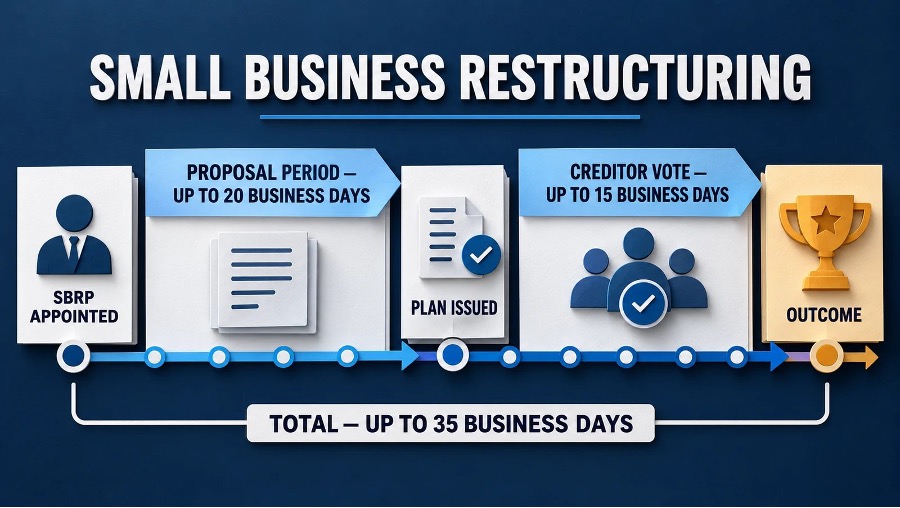
- Expect the SBR process to take up to 35 business days, which is up to 20 to prepare the plan and then up to 15 for creditors to vote on it.
- The ATO is often the biggest creditor by value, and it will generally back a plan that returns more than a liquidation would as long as there are no public interest concerns.
- Once adopted, a plan binds all affected creditors including the ATO, although the company still has to keep up with its ongoing tax obligations in full and on time.
This article is general information only, not legal or tax advice. Speak to a registered liquidator and your accountant or registered tax agent before making a decision.
What Is Small Business Restructuring?
Small business restructuring is a director-led, practitioner-supervised process that allows a financially distressed but viable small company to restructure its debts without losing control of the business. It was introduced under Part 5.3B of the Corporations Act 2001 (Cth) by reforms that took effect on 1 January 2021, and to use it the directors must first resolve that the company is insolvent or likely to become insolvent.
What sets SBR apart from voluntary administration is control: an administrator takes over in a voluntary administration, whereas under SBR the director keeps running the business, subject to restrictions on transactions outside the ordinary course of trading.
The process is overseen by a small business restructuring practitioner (SBRP), who must be a registered liquidator. The SBRP oversees the process and certifies the plan but does not take control of the company, and the goal is a plan creditors accept as better than the alternative, which is usually liquidation.
SBR is a legal insolvency process, not a Dark Horse Financial service. Where Dark Horse has a role, it is in arranging finance around a restructuring.
Is Your Business Eligible for Small Business Restructuring?
Small business restructuring eligibility comes down to a liabilities threshold combined with a clean compliance and history record. According to ASIC, on the day the restructuring practitioner is appointed the company’s total liabilities must not exceed $1 million.
Before the restructuring plan can be given to creditors, all employee entitlements that are due and payable, including superannuation, must be paid. The company must also be up to date with lodging the tax returns, notices, statements and other documents required under tax law. This is about lodgements being current, not about the tax debt being paid, and where these obligations are not completely met the ATO says the company must be able to show it is substantially compliant.
There is also a seven-year clean history rule. Neither the company, nor any current director or any person who was a director within the previous 12 months, can have been involved in a restructuring or a simplified liquidation process within the preceding seven years, subject to limited exemptions set out in the regulations.
If your company does not meet these criteria, other options such as an ATO payment plan may be worth exploring. A registered liquidator or your accountant can confirm eligibility precisely for your situation.
How the SBR Process Works, Step by Step
The SBR process runs in two timed phases, a proposal phase and a creditor vote, and typically takes around 35 business days in total once the practitioner is appointed. The steps are as follows.
- The directors appoint a registered liquidator as the small business restructuring practitioner, which formally begins the restructuring.
- The proposal period generally runs for up to 20 business days. During this time the director and the SBRP prepare the restructuring plan and a statement of the company’s affairs. The practitioner can extend this period once, by up to 10 business days, at the company’s request.
- The plan and the required supporting documents are given to creditors.
- The acceptance period generally runs for up to 15 business days. Affected creditors vote in writing and no creditors’ meeting is required, while related creditors are excluded from voting.
- The plan is adopted if a majority in value of the creditors who vote approve it, and once adopted it binds all affected creditors, including any that voted against it or did not vote at all.
Compliance with the pre-restructuring obligations is critical. If the plan is issued to creditors while employee entitlements remain unpaid or lodgements are overdue, the restructuring process will terminate.
Where ATO Debt Fits Into an SBR Plan
Because the ATO is very often the largest creditor by value in a small business restructuring, its vote frequently decides whether a plan succeeds, and the ATO has published current criteria explaining how it makes that decision.
According to the ATO’s small business restructuring guidance for tax practitioners (last updated 27 March 2026), it generally supports a plan where the plan would result in a higher payment to creditors within a reasonable period than they would receive in a winding up, and where there are no public interest concerns or risks that would make support inappropriate. It will also review draft plans and supporting financial information, such as cash flow forecasts and director loan details, if they are supplied at least five full business days before the plan is issued.
The ATO’s most common reasons for rejecting a plan are unpaid director or related entity loan accounts, a poor tax compliance history, non-payment of tax liabilities and plans that would give the business an unfair advantage over its competitors. The plan also cannot be altered once voting begins, so the best available offer needs to be presented the first time.
None of this means an ATO debt rules out SBR. It means the plan has to show creditors, the ATO included, a realistic and better outcome than liquidation. Directors should also note that a successful SBR will not remit a lockdown director penalty, or a standard director penalty that was not remitted within 21 days of the notice, so personal exposure needs to be considered separately.
If part of what a viable plan needs is funding, whether that is an upfront contribution to creditors, the practitioner’s fees, or freeing up cash flow so the business can meet its ongoing tax obligations once the plan is in place, tax debt loans are one way businesses fund that, and it is worth discussing with your adviser. If that is the case, it may be worth taking the time to talk to the team at Dark Horse, as that conversation can run alongside, not instead of, advice from your liquidator or accountant.
Small Business Restructuring vs Voluntary Administration vs Liquidation
These three processes solve different problems. SBR suits smaller, still-viable businesses that want to keep trading, voluntary administration suits larger or more complex businesses that need a formal moratorium, and liquidation applies when the business is no longer viable and needs to be wound up.
| Small Business Restructuring | Voluntary Administration | Liquidation | |
|---|---|---|---|
| Legal basis | Part 5.3B, Corporations Act 2001 (Cth) | Part 5.3A, Corporations Act 2001 (Cth) | Parts 5.4 to 5.6, Corporations Act 2001 (Cth) |
| Who controls the business | The director retains control, subject to restrictions | An external administrator takes full control and directors’ powers are suspended | A liquidator takes control and trading ceases except to complete the wind-up |
| Eligibility | Total liabilities not exceeding $1 million, entitlements paid, lodgements current and a seven-year clean history | No size limit; the company is, or is likely to become, insolvent | No size limit; a creditors’ resolution or a court order based on insolvency |
| Process length | Around 35 business days: up to 20 to propose and up to 15 to vote | First creditors’ meeting within 8 business days; second meeting generally within about 25 business days (30 over Christmas and Easter) | Variable, from months to years depending on the complexity of the assets |
| Creditor process | Written vote by affected creditors, no meeting required, majority in value | At least two formal creditors’ meetings | Initial resolution or court order, then ongoing reporting with no vote on a plan |
| Typical outcome | An adopted plan binds all affected creditors, including the ATO | A Deed of Company Arrangement, return to director control, or liquidation | The company is wound up and assets are distributed in statutory order of priority |
| Best suited to | Small, otherwise viable companies that want to keep trading | Larger or more complex companies needing a formal moratorium and negotiation process | Companies that are not viable and need an orderly wind-up |
Practitioner fees vary by firm and by the complexity of each case, so it is best to ask a registered practitioner for a quote rather than relying on a typical figure. For a closer look at how the administration process works, see our article Voluntary Administration Explained, and for businesses that are not yet at the restructuring stage, there are practical ways to pay off tax debt quickly.
What Happens After a Restructuring Plan Is Approved (or Rejected)?
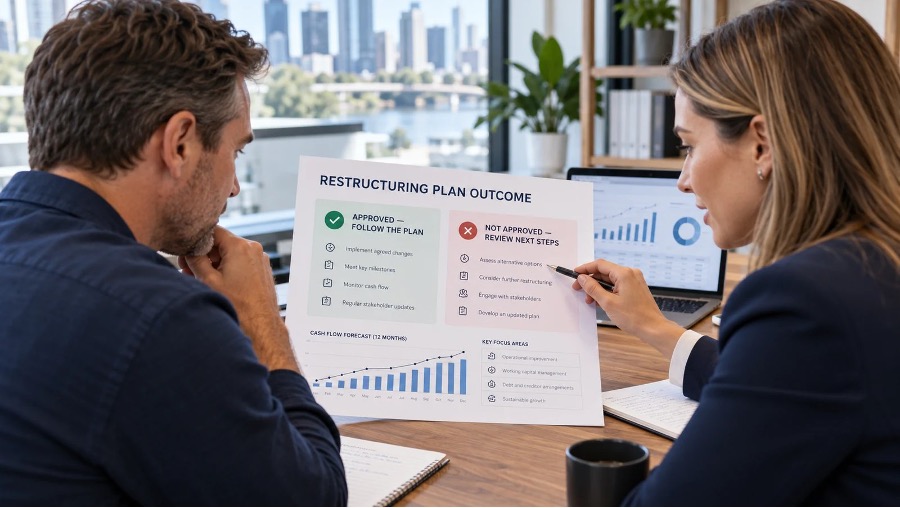
An approved plan binds the company and its affected creditors going forward, but it does not pause the company’s ongoing tax obligations, while a rejected plan can lead towards liquidation or to business owners seeking urgent funding to support the business’s cash flow and liquidity requirements.
Once adopted, the plan governs how affected creditors’ debts, including the ATO’s, are dealt with, and the company exits the restructuring bound by its terms. The ATO’s guidance stresses that ongoing tax reporting and payment obligations must continue to be met in full and on time, and that a failure to do so can lead to stronger enforcement action even where the company is otherwise meeting its obligations under the plan.
If the plan is not approved by the required majority in value, the proposal lapses and the restructuring comes to an end. The company does not automatically go into liquidation, but it commonly ends up there if no other viable path exists, and the exact outcome will depend on the circumstances of each case. For that reason, directors should work through both outcomes with their SBRP or accountant before the plan is proposed rather than after a vote has failed.
Conclusion
Small business restructuring gives eligible small companies a way to deal with their debts, including ATO debt, without handing control of the business to an external administrator. Eligibility, plan design and ATO engagement are specialist matters though, and as this article is general information rather than legal or tax advice, the decision should be made with a registered liquidator and your accountant.
Where funding is part of what makes a restructuring plan workable, tax debt finance can be a practical next step for that side of the equation. Our case studies show how finance has supported real businesses working through ATO debt situations, and if you would like to discuss your circumstances, please get in touch with the Dark Horse team.
FAQ
Small business restructuring is a formal process that sits under Part 5.3B of the Corporations Act 2001 (Cth) and has been available since 1 January 2021. An eligible small company can use it to put a debt restructuring plan to its creditors while the director carries on running the business, with a registered small business restructuring practitioner supervising the process from start to finish.
Broadly, the company’s total liabilities must not exceed $1 million, employee entitlements must be paid and tax lodgements must be current before the plan is issued, and neither the company nor its directors can have used SBR or simplified liquidation in the past seven years. A registered liquidator can confirm eligibility for your situation.
No. The company must be up to date with its tax lodgements, including returns, activity statements and notices, but the ATO debt itself does not need to be paid before the process begins. The tax debt is usually dealt with as part of the restructuring plan, alongside the debts owed to other affected creditors.
There is no guarantee. The ATO’s published guidance states that it generally supports plans that would return more to creditors within a reasonable period than a liquidation would, and that raise no public interest concerns. Because the ATO is often the largest creditor by value, its vote frequently decides whether a plan is adopted.
In small business restructuring the director keeps running the business throughout the process. In voluntary administration an external administrator takes full control, directors’ powers are suspended and at least two formal creditors’ meetings are held. SBR is designed specifically for smaller companies with simpler debt structures and total liabilities of no more than $1 million.
If the required majority in value of voting creditors does not approve the plan, it lapses and the restructuring ends. The company then needs to consider its next step with its practitioner or accountant. In practice this often leads towards liquidation, although the exact outcome depends on the circumstances of the individual case.
Sources and Methodology
Figures and timeframes in this article were checked against the following sources in October 2026.
- Australian Securities & Investments Commission, Small business restructuring and the restructuring plan, asic.gov.au (accessed October 2026)
- Australian Taxation Office, Small business restructuring (guidance for tax professionals), ato.gov.au, last updated 27 March 2026 (accessed October 2026)
- Worrells, How the small business restructuring process works, worrells.net.au (accessed October 2026)
- Corporations Act 2001 (Cth), Parts 5.3A, 5.3B and 5.4 to 5.6
Disclaimer
This article is general information, not legal or tax advice. Whether SBR is right for your business depends on your specific circumstances, so speak to a registered liquidator or small business restructuring practitioner, and your accountant or registered tax agent, before making a decision. Dark Horse Financial Pty Ltd is a Credit Representative No. 465 325 of Buyers Choice Licencing Pty Ltd.