
Caveat loan eligibility criteria come down to three things a lender needs to see: a property you own in Australia, enough equity in that property to secure the loan, and a clear plan for how the loan will be repaid. This guide sets out the property, equity and documentation conditions a business needs to meet to qualify for a caveat loan, and what lenders look for at each step.
What separates caveat loans from standard bank lending is how eligibility is assessed. A bank will usually start with your credit file, financial statements and trading history, whereas a caveat lender is primarily concerned with the strength of the property security and the exit strategy, so a business with a short trading history or an imperfect credit file can still be a strong candidate if the security and the repayment plan stand up.
Dark Horse Financial is a finance broker, not a lender. We arrange caveat loans through a large panel of lenders across banks, non-banks and private financiers, matching each application to the lender whose policy best fits the property and the exit strategy.
Key Takeaways
- Lenders assess caveat loan eligibility mainly on the property and the exit strategy, so your credit file and trading history are not the deciding factors the way they would be with a bank.
- You need to own an Australian property, or hold a registered interest in one, for the caveat to be lodged against.
- How much you can borrow comes down to your usable equity and the maximum loan-to-value ratio (LVR) the lender will accept.
- A realistic exit is essential, whether that is selling a property, refinancing or another confirmed source of repayment.
- Approval on a straightforward application can take as little as 24 to 48 hours and settlement can follow within up to 72 hours of approval, though this varies from lender to lender.

What Is a Caveat Loan?
A caveat loan is a short-term loan secured by placing a legal caveat on the title of a property. The lender uses this caveat to protect their interest in the asset while the loan is active. The caveat restricts the property owner from selling or transferring the property without repaying the loan.
Unlike a full mortgage, a caveat loan does not need to sit in first position on the title, and many lenders will accept a caveat behind an existing mortgage. This is a large part of why caveat loans can be arranged far more quickly than a refinance or a registered second mortgage, which require more formal documentation and registration.
These loans are usually used for:
- Business cash flow
- Paying an urgent ATO or creditor debt
- Bridging finance while waiting on a property sale
- Covering a settlement shortfall
- Funding a time-critical business opportunity
Because the loan is secured by a caveat lodged against the property’s title, eligibility hinges on the applicant actually owning, or holding a registered interest in, that property. Without a title to lodge the caveat against, there is no security for the lender, which is why property ownership is the first criterion every lender checks and the foundation for everything covered in the next section.
Key Caveat Loan Eligibility Criteria
Caveat loan eligibility rests on three pillars: the property, the equity in it, and the exit strategy. Credit history generally plays little or no part, as many caveat lenders do not review credit files at all, while the type and location of the property tend to influence the terms of the loan rather than decide whether it can be approved. The table below summarises what lenders typically look for.
Caveat Loan Eligibility at a Glance
| Eligibility Factor | What Lenders Typically Require | Why It Matters |
|---|---|---|
| Property Ownership | Ownership of, or a registered interest in, real property in Australia, held by a company or trust applicant or its directors | The caveat must be lodged against a title, so without property there is no security |
| Equity / Loan-to-Value Ratio (LVR) | Enough usable equity after existing mortgages and caveats, within the lender’s maximum LVR | Equity determines how much can be borrowed and how much risk the lender carries |
| Exit Strategy | A clear, realistic plan to repay, such as sale, refinance or another confirmed source of funds | Caveat loans are short term, so lenders need confidence in how the loan will end |
| Credit History | Many lenders do not review credit files or credit history; defaults and impaired credit are not usually a barrier | Security and exit strategy are the determining factors, not the credit file |
| Property Type & Location | Residential, commercial or industrial property, including land, with value and location assessed by the lender | Influences how easily the lender could recover funds and therefore the LVR offered |
Lenders will also want to see that the funds are for a legitimate business purpose. Companies and trusts can apply, while individuals cannot apply directly, and you do not need a long trading history to qualify. If you have worked through these criteria and believe your business meets them, you can explore caveat loans in Australia to see how the product is structured and what it can be used for.
Property Ownership Requirements
To qualify for a caveat loan you must own a property in Australia or hold a registered legal interest in one, because this property serves as security for the loan and it is the title the caveat gets lodged on. If you do not currently own real estate, you will not be eligible for a caveat loan.
Having existing mortgages or caveats already on the title does not necessarily stop an application. Some private lenders are comfortable sitting behind them, others would rather pay them out and consolidate everything into the one loan, and which approach applies depends on the lender and the equity left in the property.
Equity and Loan-to-Value Ratio (LVR) Requirements
One of the most important caveat loan requirements is sufficient equity in your property. Lenders calculate this by determining the market value of your property and subtracting any outstanding loans or encumbrances, and the figure left over is your usable equity.
In general, lenders will only fund up to a certain percentage of the property’s value, known as the loan-to-value ratio. The maximum LVR differs between lenders and is influenced by the property type, its location, the loan term and the overall risk of the deal, which is one of the reasons matching an application to the right lender on the panel matters as much as it does.
The more equity you hold, the greater your borrowing capacity and the more lender options are likely to be available.
Exit Strategy Requirements
Lenders want to know exactly how you intend to repay the loan. Because caveat loans are short-term facilities, a well-defined and realistic exit strategy is essential, and it is often the factor that carries the most weight after the property itself.
An exit strategy typically takes one of three forms:
- The sale of the secured property or another asset
- A refinance to a longer-term business loan or mortgage
- An incoming capital event, such as a confirmed contract payment, an investor contribution or the release of funds from a separate transaction
A lender will look at whether the exit is realistic and supported by evidence, for example a signed contract of sale or a refinance pre-approval. The stronger and better documented the exit, the more confidence a lender will have in the application.
Documents Needed for a Caveat Loan Application
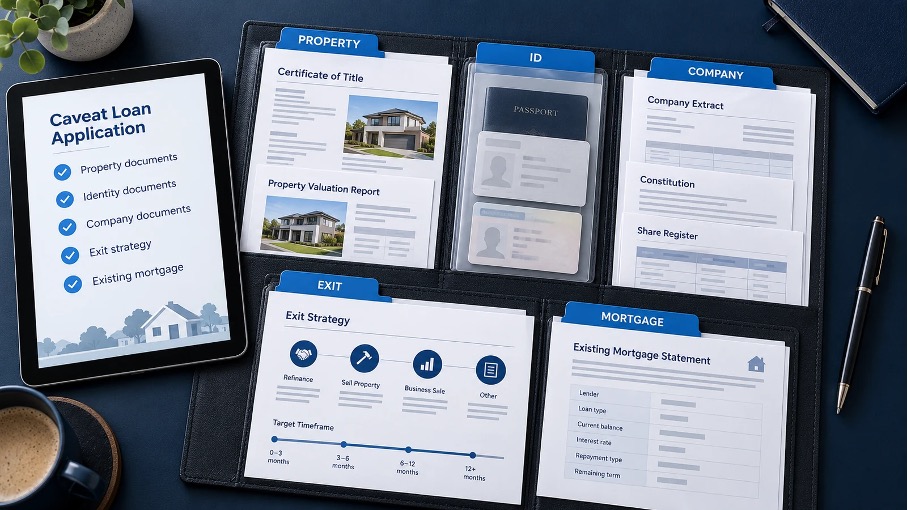
Having the right documents ready is one of the simplest ways to keep the caveat loan application process moving, because incomplete applications are the most common reason for delays. While requirements vary, most lenders will ask for the following:
- Proof of property ownership, such as a title search or rates notice
- Photo identification for each director, such as a driver’s licence or passport
- Company or trust details, including the ABN and trust deed where relevant
- A short explanation of the loan’s business purpose
- Evidence of the exit strategy, such as a contract of sale, refinance approval or confirmation of incoming funds
- Statements for any existing mortgage or loan secured against the property
Loan contracts will often need to be delivered to a solicitor, who will provide you with advice about the loan contract and verify your identity before settlement.
Document requirements can vary from one lender to another within the panel, so it is worth confirming the exact list with your broker before you apply.
Caveat Loan Eligibility vs Second Mortgage Eligibility: Which Is Easier to Qualify For?
Business owners researching eligibility often compare caveat loans with second mortgages, as both allow you to borrow against the equity in a property you already own. When you look at caveat loan vs second mortgage eligibility side by side, the core requirements are similar: property ownership, sufficient equity and a credible plan for repayment.
The difference lies mainly in structure and process. A second mortgage is registered on title as a formal mortgage behind the first, which involves a mortgage deed, more extensive documentation and a registration process. A caveat loan is secured by lodging a caveat rather than a full mortgage, so documentation is lighter and approval is generally faster.
That does not make a caveat loan the easier option in every case. Caveat loans are designed for short terms, generally weeks to a few months, and a lender will look closely at whether the exit strategy can realistically be met within that window. A second mortgage can run for longer, which may suit a business with a larger or less time-critical funding need even though it takes more time and paperwork to put in place.
In practice the choice is a trade-off between speed and product structure. If the funding need is urgent and the exit is clear and close at hand, a caveat loan is usually the better fit, whereas a longer or larger requirement may be better served by a second mortgage. A broker can assess which product suits the property, the amount and the exit strategy before an application is lodged.
Can You Get a Caveat Loan with Bad Credit?
One of the major advantages of caveat loans is that many lenders do not review credit files or credit history at all. If you have bad credit, defaults or have been declined by banks, you may still be eligible.
Lenders are focused on the strength of your property security and the likelihood of repayment through your exit strategy. This is partly structural. The National Credit Code, which sets out the consumer protections that govern retail lending, applies to credit provided wholly or predominantly for personal, domestic or household purposes, so credit provided predominantly for business purposes generally sits outside it, and this is part of why business-purpose products such as caveat loans can be assessed more quickly and with a stronger focus on security.
Being honest and upfront about your financial history is still the best approach, as it allows your broker to match the application to a lender whose policy suits your circumstances from the outset.
Conclusion & Next Steps
Caveat loan eligibility comes down to property ownership, sufficient equity and a clear exit strategy, rather than credit history. If your business owns property in Australia, has usable equity in it and can show how the loan will be repaid, there is a good chance a lender on the panel will consider the application.
Dark Horse Financial arranges caveat loans through a large panel of lenders, including banks, non-banks and private financiers, which broadens the chance of finding a lender whose policy fits your property and exit strategy. If you would like to know where your business stands, get assessed for a caveat loan and our team will take you through your options.

FAQs
There is no minimum credit score, because caveat loans are assessed on property equity and exit strategy. Many lenders that provide caveat loans do not review credit files or credit history at all, which makes them a viable option for borrowers with impaired credit, and the strength of the security and the exit strategy are the determining factors.
The equity required depends on each lender’s maximum loan-to-value ratio, as explained in the Equity and LVR section above. Lenders subtract existing mortgages and caveats from the property’s market value to calculate usable equity, and the maximum they will lend varies with the property type, location, loan term and the overall risk of the deal.
Yes, because a caveat loan is secured against property rather than approved on credit history. Many caveat lenders do not review credit files at all, so a default on file is not usually a barrier, and approval comes down to whether the security is strong enough and the exit strategy is realistic and well supported.
In most cases you will need proof of property ownership, photo ID, company or trust details, a note on the loan’s business purpose, evidence of your exit strategy and statements for any loans already secured against the property. The exact list depends on the lender, and your broker will confirm it with you before anything is lodged.
Straightforward applications from eligible borrowers can be approved in as little as 24 to 48 hours, although this is not guaranteed for every applicant. Settlement can follow within up to 72 hours of approval depending on the lender, and providing complete property, identity and exit strategy information early helps avoid delays.
Sources and Methodology
This article was reviewed against Dark Horse Financial’s live Caveat Loans in Australia page and the existing version of this article. The regulatory scope of the National Credit Code is drawn from Schedule 1 of the National Consumer Credit Protection Act 2009 (Cth) and related ASIC material. Approval and settlement timeframes reflect typical outcomes for straightforward applications and vary by lender.
Disclaimer: Loans and the benefits of loan products are available to approved applicants only. Information on this page is general in nature, it does not take into account your personal situation. This information is not intended to replace professional advice and should not be relied upon for any reason. You should always seek professional advice for finance, tax and accounting matters before making a decision or taking any action. Dark Horse Financial Pty Ltd is a Credit Representative No. 465 325 of Buyers Choice Licencing Pty Ltd.
Get a Caveat Loan Today
For expert help and tailored caveat loan solutions, contact the team at Dark Horse Financial today. We’re here to support your funding journey with speed, flexibility, and personalised service.