
If you are working out how to fund your startup and asking whether it is possible to get an unsecured startup business loan, the short answer is yes, although access and terms depend heavily on how long the business has been trading and how much cash flow it can show through its business bank account. Unsecured funding for startups does exist, but it is more limited than it is for established businesses, and the terms tend to reflect the extra risk a lender is taking on.
For that reason some startups draw on more than one source of funding, at least in the early years, and it is common to see a founder start out on personal savings and then add a modest unsecured facility once revenue begins to come through, with larger limits and better terms becoming available as the business builds its trading history.
In this guide we look at the unsecured loan options open to startups and what lenders want to see before they approve one, as well as the alternative funding paths that are worth considering before, or alongside, a loan application.
Key Takeaways
- Unsecured business loans are available to startups from as little as three months of trading, with more options at 12 months and more again at 24 months.
- Unsecured lenders assess startups on a historical look at their business bank statements, so a business needs to demonstrate cash flow through its accounts before it applies.
- A director's guarantee is a standard requirement for unsecured business lending, as it is for virtually all business lending in Australia, so unsecured does not mean no personal liability.
- Some startups combine two or more funding sources, such as personal savings and an unsecured facility.
- Unsecured lending for startups is an expensive form of funding, so business owners should be realistic about the rates lenders will charge and whether the repayments fit their business model and cash flow.

Why Startups Struggle to Qualify for Unsecured Business Loans
The main reason startups find unsecured finance harder to obtain is simple. An unsecured loan has no property or equipment behind it, so the lender is relying almost entirely on the business’s ability to repay, and the usual way a lender measures that ability is by looking at trading history, which is exactly what a new business does not yet have.
For an established business, a lender can review months or years of bank statements, revenue patterns and repayment behaviour. For a startup, that record is short or does not exist at all, which makes the risk harder to assess and price. This does not mean startups cannot qualify, but it does mean the business has to build up some history before an unsecured lender will consider it.
Unsecured lenders do not substitute forecasts, contracts, purchase orders or the director’s personal financial position for that missing history. The assessment is based on a historical look at the business bank account statements, which means a startup’s chance of approval comes down to the cash flow it has already demonstrated through its accounts before it applies, not what it expects to earn in the future.
Across Dark Horse’s panel of lenders, some will consider a business with as little as three months of trading where the statements show consistent cash flow, while others will not look at an unsecured application until the business has a full year or two of statements behind it. There is no single rule that applies across the market, which is why understanding each lender’s policy matters before an application is submitted.
Ways to Fund a Startup Beyond a Business Loan
A business loan is only one of several ways to fund a new venture, and for many founders it is not the first step. The following five funding paths are commonly used by Australian startups, either on their own or in combination.
- Bootstrapping and personal savings. Funding the business from your own savings keeps you in full control and avoids repayments in the early stages, although it limits how quickly you can grow and places your personal finances at risk.
- Borrowing from family or friends. This can be a flexible and low-cost source of early capital, but it should be documented properly with clear repayment terms so that the arrangement does not strain personal relationships if the business takes longer than expected to become profitable.
- Government-backed loans and grants. Federal, state and territory governments offer grants and programs for particular industries, regions and activities such as research and development or export, and the Australian Government’s business.gov.au Grants and Programs Finder is a useful place to start searching.
- Equity financing through angel investors or venture capital. Investors provide capital in exchange for a share of ownership, which suits startups with high growth potential, although founders give up part of the business and often some control over decisions.
- Crowdfunding. Reward-based or equity crowdfunding platforms allow a startup to raise smaller amounts from a large number of supporters, and a successful campaign can also help to prove there is real demand for a product.
Some startups combine two or more of these paths with an unsecured loan or line of credit, using equity or savings for longer-term investment and debt finance for working capital needs such as stock, wages and supplier payments.
Can Startups Get an Unsecured Business Loan? What Lenders Actually Look For
Startups can get an unsecured business loan, but eligibility depends largely on how long the business has been trading, and the requirements tighten or loosen depending on the lender and the product. The minimum time trading for a startup unsecured loan is generally three months, although at that stage the number of lenders is small, the amounts available are usually modest and the terms reflect the higher level of risk. Once a business has been trading for more than 12 months the range of options widens considerably, and from 24 months there are more lenders again, with better terms, larger limits and pricing that starts to reflect a proven track record.
Beyond time in business, lenders typically assess the following:
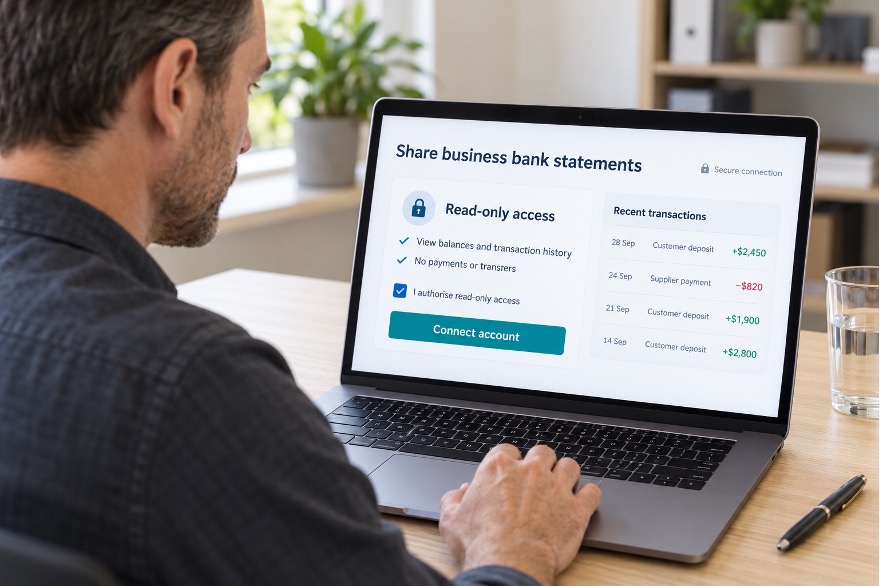
- Revenue and cash flow. This is the core of the assessment and is done through a read-only view of the business bank account, so the statements need to show consistent deposits and enough surplus cash flow to cover the new repayments.
- Credit history. Both the business and director credit files are reviewed, although some non-bank lenders place more weight on current cash flow than on past credit issues.
- Director’s guarantee. As with virtually all business lending in Australia, lenders will ask the director or directors to provide a personal guarantee, which means the director is personally responsible for the debt if the business cannot repay it.
The guarantee point is important because many founders assume “unsecured” means no personal exposure, which is not the case, and it is worth understanding exactly what you are signing before you accept any offer.
It is also important to be realistic about cost. Unsecured lending for startups is an expensive form of funding, because the lender is taking on more risk with a newer business and has no security to fall back on, so business owners should look carefully at the rates lenders are likely to charge and ask whether that cost fits their business model, their margins and their capacity to make the repayments week in and week out.
Because each lender weighs these factors differently, the most effective approach is to match your business’s circumstances to a lender whose policy fits, rather than submitting applications to multiple lenders and hoping one is approved, which can leave several enquiries on your credit file. If you are ready to move from understanding eligibility to looking at real options, you can explore your business loan options through Dark Horse’s panel of lenders.
Startup Funding Options Compared: Unsecured Loan vs Line of Credit vs Private Lending
Startups that do qualify for debt finance usually have a choice between a few different structures. Each has different eligibility settings, speed and security requirements, and the right one depends on how the funds will be used and what the business can show a lender.
| Option | Typical Eligibility for Startups | Speed | Security Required |
| Unsecured Business Loan | Available from around three months of trading, with more options from 12 months and more again from 24 months; assessed on the cash flow shown in business bank statements | Can be faster than secured products, with some no doc products approved within 24 to 48 hours for eligible businesses | No property or asset security, although a director’s guarantee is standard |
| Business Line of Credit | Assessed on much the same trading history settings as an unsecured loan, with the limit generally set by revenue and cash flow | Once the limit is approved, funds can be drawn, repaid and drawn again as the business needs them | Usually unsecured with a director’s guarantee, terms vary between lenders |
| Private Lending | More flexible on trading history, as it is often assessed on the underlying deal or asset rather than the age of the business | Can be faster than traditional bank finance because there are fewer standard checks | Usually secured against property or another asset |
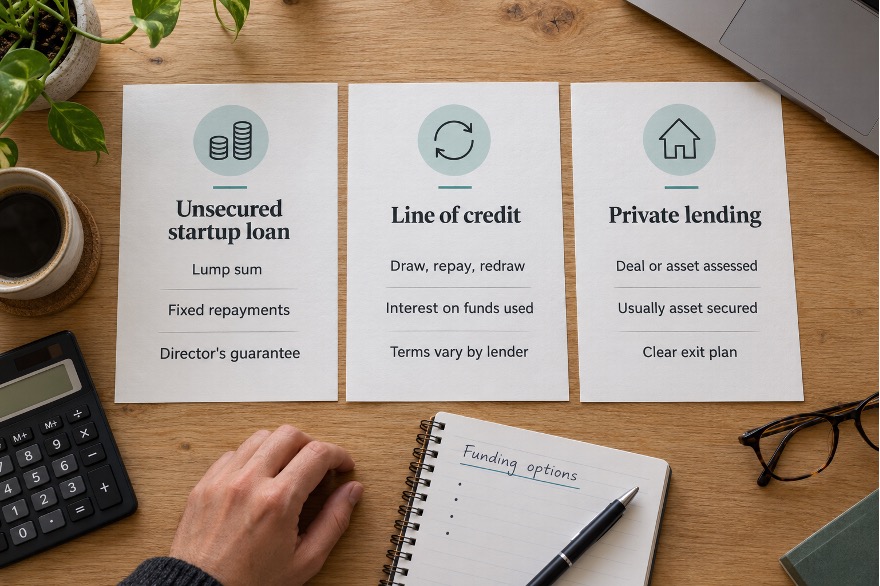
An unsecured business loan provides a lump sum that is repaid over a fixed term, which suits a defined one-off need such as fitting out premises or buying initial stock. A business line of credit works more like an overdraft, where the business is approved for a limit and only pays interest on what it uses, so it tends to suit ongoing working capital needs where the timing and amount of expenses are less predictable.
Private lending sits in a different category. Because it is usually secured against property or another asset, the age of the business matters less, and the lender focuses more on the value of the security and the exit strategy. For a founder who owns property but has a very new business, private lending can sometimes open doors that unsecured lenders will not, although the cost is generally higher than bank finance and it should be approached with a clear plan for repayment or refinance.
You can read more about how these products work on our pages covering unsecured business loans, business lines of credit and private lending.
How to Apply for a Startup Business Loan: Documents and Steps
Because an unsecured startup loan is assessed on bank statements, the application itself is relatively simple. Before applying, a startup founder should have the following in place:
- Business bank account statements covering the full period the business has been trading, usually provided through read-only access
- The business’s ABN and company or trust details
- Identification for each director
- Details of any existing business debts or facilities, including repayment amounts and remaining terms
- A clear idea of how much is needed and what the funds will be used for
The most useful thing a startup can do well before applying is make sure all business income runs through the business bank account, rather than being split across personal accounts or other platforms, so that the statements reflect the true level of trading. Dark Horse does not assess or approve applications itself, it arranges finance through a large panel of banks, non-bank lenders and private financiers, and the role of the broker is to match the business’s statements and time trading to the one lender whose policy fits.
It also helps to be realistic about the amount you are asking for. A startup that requests a figure in line with the cash flow showing in its bank statements, and that it can comfortably repay at the rates unsecured lenders charge, is more likely to receive a positive response than one asking for the maximum a lender might offer an established business, and a smaller first facility that is repaid well can make it easier to access larger amounts later as the trading history builds.
Conclusion and Next Steps
Unsecured funding is possible for some startups, but the right path depends on how long the business has been trading, how much it needs and the cash flow it can show through its bank statements. For some founders the answer is a combination of funding sources, with an unsecured loan or line of credit sitting alongside their own savings, and because unsecured startup lending is an expensive form of funding, it only makes sense where the business model can support the repayments.
Because lender policies on startups vary so widely, matching your business to the right lender from a broad panel matters more than chasing one particular loan type. If you would like help working out which funding structure suits your startup and which lender is the right fit, talk to our team.
Frequently Asked Questions
Access is possible but limited, because unsecured lenders assess startups on the cash flow shown in their business bank statements rather than on forecasts or contracts. Most want at least three months of trading, so a business with no history at all will generally need to rely on savings, a secured option or another funding source until its accounts show consistent cash flow.
The difference is whether the lender requires an asset as security, not the interest rate. A secured loan is backed by property, equipment or another asset the lender can recover if repayments stop. An unsecured loan has no asset security, although, as with virtually all business lending, the lender will still require a director’s guarantee, which makes the director personally liable for the debt.
The amount varies by lender and depends on the revenue and cash flow showing in the startup’s bank statements, so there is no single figure that applies to every business. For startups, unsecured loans generally range from around $10,000 up to $500,000, with smaller amounts more typical in the early months and larger limits becoming available as the business builds a trading track record.
Yes. In Australia, a director’s guarantee is required in virtually all forms of business lending, secured or unsecured, so a startup should expect to provide one. Non-recourse lending without a guarantee can occur on some property-secured loans, but it is rare and limited to specific scenarios. Before signing, make sure you understand exactly what the guarantee covers, and get independent legal advice if anything about it is unclear.
Timeframes depend on the product and the lender. Because unsecured startup lending is assessed on business bank statements, many lenders can review an application quickly once read-only access is provided, and at least one lender on our panel that funds startups can assess, approve and settle on the same day, while larger amounts and secured options usually take longer because there is more for the lender to review.
Sources and Methodology
This article draws on Dark Horse Financial’s experience arranging business finance for Australian businesses through a large panel of lenders, along with the eligibility information published on our unsecured business loans page. Information on government grants and programs is available through the Australian Government’s business.gov.au Grants and Programs Finder. Lender criteria change regularly, so eligibility, amounts and timeframes should always be confirmed against current lender policy before applying.
Disclaimer
The information in this article is general in nature and does not take into account your personal objectives, financial situation or needs. You should consider whether it is appropriate for your circumstances and seek independent professional advice before making any financial decision. Any finance is subject to lender approval, terms and conditions. Dark Horse Financial Pty Ltd is a Credit Representative No. 465 325 of Buyers Choice Licencing Pty Ltd.
Kick-Start Your Business With Business Loans
We understand how important financing is to starting a new business. Reach out to us and we’ll help you access the best rates and terms from lenders across Australia.
Start your business journey today.